T1a · The Diesel Dudes
Ram 2500 Fuel Filter Service: What the Water In Fuel Light Means and When Both Filters Are Due
The light your truck actually uses
On a diesel Ram 2500 the fuel filter warning is the Water In Fuel Indicator Light.
The Water In Fuel Indicator Light will illuminate when there is water detected in the fuel filters.
That is worth being precise about, because the light is not a countdown to a filter change and it is not a general fuel system alarm. It is a report from the water separator about what is sitting in the filter housings right now. Diesel fuel picks up water through condensation and through the supply chain, and the filter assemblies are built to collect it so the injection system never sees it. When enough of it accumulates, the light comes on.
Count the chimes: the light means two different things
This is the single most useful thing to know about the warning, and it is easy to miss because both cases turn on the same lamp.
When there is genuinely water in the separator, the Water In Fuel Indicator Light will illuminate and an audible chime will be heard five times.
The manual's instruction for that case is immediate: At this point you should stop the engine and drain the water from both of the filters.
One chime is a different message. If the Water In Fuel Indicator Light comes on and a single chime is heard while you are driving, or with the ignition switch in the ON position, there may be a problem with your water separator wiring or sensor.
So the chime count is the diagnosis. Five chimes and the truck is telling you there is water to remove. One chime and it may be telling you the sensor circuit itself is at fault, which means draining may not clear the light and the next step is diagnosis of the wiring and sensor rather than another drain. Neither case is one to ignore, but they lead in opposite directions and the sound is what separates them.
What to do when the light stays on
The order of operations is the part that matters, and the manual is blunt about it.
Draining is called for while the light is on: Drain the fuel/water separator filters when the Water In Fuel Indicator Light is ON.
And the sequence is not negotiable: If the Water in Fuel Indicator Light remains on, DO NOT START the engine before you drain the water from the fuel filters to avoid engine damage.
Read that as written. Draining comes first and starting comes second. Modern common-rail injection runs at very high pressure through extremely tight clearances, and water is not a lubricant. That is why the instruction is phrased around damage rather than around performance.
There is a matching prohibition at the other end: Do not drain the fuel/water separator filter when the engine is running.
Both instructions point the same way. The drain happens with the engine off, and the engine stays off until the drain is finished.
Where the filters are, and how the drain actually works
Both filter positions get drained, not just the one that is easier to reach.
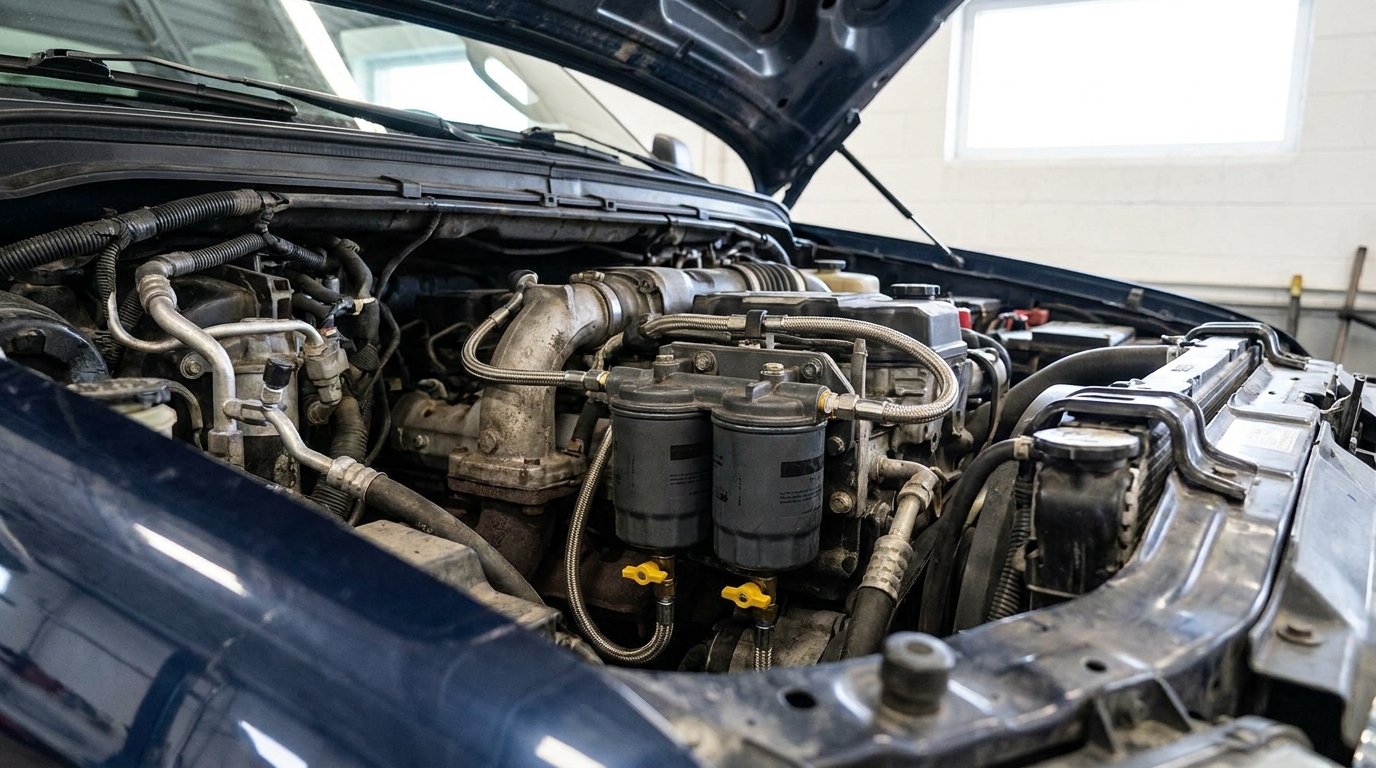
On the current truck they are together: There are two engine mounted fuel filter assemblies mounted side-by-side on the driver side of the engine.
That arrangement makes the job a single-location one: The best access to the water drain valves is from under the hood.
The procedure has a time window built into it, which most write-ups leave out. Within 10 minutes of vehicle shutdown, turn the engine mounted filter drain valves (located on the side of the filter assembly) counterclockwise 1/4 turn.
Then turn the ignition switch to the ON position, and allow any accumulated water to drain.
The ten-minute window is not arbitrary. Water separates and settles when the fuel stops moving, and the manual's sequence has you open the valves while it is still collected at the bottom of the housings rather than stirred back through the fuel.
Closing the valves has its own specification, and this is where an expensive mistake hides. Rotate the 1/4 turn drain valves fully clockwise to their stops.
Then, and only by this much: Continue turning the drain 1/2 of a turn to properly compress the seal.
The manual states the consequence of going further, and it is not a leaking valve you can nip up later — over-tightening will require the entire sensor to be replaced.
Half a turn past the stop is the whole instruction. There is no version of this job where more torque is better, and a drain valve is not a fitting that rewards a wrench.
After the drain: the two timings that fool people
A light that is still on immediately after you finish is not automatically a failed repair.
Upon proper draining of the water from both fuel filters, the Water In Fuel Indicator Light will remain illuminated for approximately 10 seconds.
The other case takes far longer to clear. If the water was drained while the engine was running, the Water In Fuel Indicator Light may remain on for approximately three minutes.
Those two numbers explain most of the confusion that follows a successful drain. Give the system the time the manual allows before concluding that the drain did not work or that the sensor is faulty. If the light is still on well past those windows, you are back to the single-chime case and the sensing circuit.
The truck will not remote-start with the light on
This one surprises people who have not connected the two systems. Remote start checks the diesel warning lamps before it will run the engine, and the conditions include that the Water In Fuel Indicator Light is not illuminated.
So a truck that refuses to remote-start on a cold morning may be refusing for exactly the reason the manual gives for not starting it by hand. The feature is enforcing the same rule.
If you drained out more than a little fuel
Draining water usually costs you a splash of diesel and nothing else. Past a certain point, though, the fuel system needs priming rather than just starting, and the manual sets the threshold: If more than a couple ounces/milliliters of fuel have been drained, the priming directions apply.
The priming sequence starts with fuel in the tank: Add a substantial amount of fuel to the tank, approximately 2 to 5 gal (8 L to 19 L).
Cranking has a limit that protects the starter: Do not engage the starter motor for more than 15 seconds at a time.
And a rough-running engine immediately afterwards is expected rather than alarming: The engine may run rough until the air is forced from all the fuel lines.
One prohibition sits over the whole job: Do not open the high pressure fuel system with the engine running.
That is the line between a maintenance task and a hospital visit. High-pressure diesel injection operates at pressures that will inject fuel through skin, and the pressure is present whenever the engine is turning.
Replacing the filters is a separate job from draining them
The other reason people search for fuel filter service is the maintenance schedule, and it has nothing to do with the warning light.
Cummins states the interval plainly: Maintenance intervals for fuel filter replacement remains at 15,000 miles (24,000 km).
The 2026 handbook places the same job in its schedule alongside the oil change, and reading that row in full is worth the space: Every 15,000 Miles (24,000 Km) ●Change engine oil every 15,000 miles (24,000 km) or 12 months or 500 Hours or sooner if prompted by the oil change indicator system, whichever comes first2 ●Replace both engine mounted fuel filters
So the filters are not a job you schedule separately and try to remember. They fall due with the oil, which makes them a same-visit item on a diesel Ram 2500 and removes the arithmetic entirely. If you are having the oil done, the filters are due.
Both filters are named together, so the job is a pair rather than a single cartridge. Draining water is routine maintenance you may do many times between replacements; replacing the filters is what the mileage number asks for. A truck that has just had its water drained is not a truck that has had its filters serviced.
The two positions are not specified alike, which is the step where money gets wasted. The front position is the finer of the two: Must meet 3 micron rating (front mounted filter).
The rear is the coarser: Must meet 5 micron rating (rear engine mounted filter).
Ordering a matched pair, or fitting them in the wrong positions, changes the filtration the fuel system was designed around. The handbook states the cost of getting it wrong: Using fuel filters that do not meet the manufacturer's filtration and water separating requirements can severely impact fuel system life and reliability.
Two details in the fitting procedure catch people who have done other filters before. The first is counter-intuitive: Do not prefill the fuel filter when installing a new fuel filter.
The manual's reasoning is contamination, and its instruction is to install the filter dry and allow the in-tank lift pump to prime the fuel system.
The second is a torque figure rather than a feel: Install lid onto housing and tighten to 22.5 ft-lb.
Between those two steps sit the details that decide whether the new filter seals. The sealing surfaces get attention first: Wipe clean the sealing surfaces of the lid and housing.
Then the o-ring, which is a new part rather than a reused one: Install new o-ring back into ring groove on the filter housing and lubricate with clean engine oil.
And the cartridge stays sealed until the last possible moment: Do not remove cartridge from bag until you reach this step in order to keep cartridge clean.
That last instruction is the same reasoning as the no-prefill rule. Everything in this procedure is arranged to keep debris out of a system whose injectors work to clearances measured in microns, which is also why the filters are specified by micron rating in the first place.
Cold weather and fuel choice change what the filter has to do
The filter housings are heated, which is a detail worth knowing before blaming a filter for a cold-morning no-start: A 12 Volt heater built into the fuel filter housings aid in preventing fuel gelling.
Fuel choice matters to the same components. For normal running the engine is built around Number 2 Ultra Low Sulfur Diesel Fuel or Number 2 Ultra Low Sulfur Climatized Diesel Fuels.
The heater in the housings is one of three cold-weather aids on this engine, and knowing which does what saves a wasted diagnosis. One warms the coolant: The engine block heater is a resistance heater installed in the water jacket of the engine just above and behind the oil filter.
The third works in the cylinders: A glow plug system both improves engine starting and reduces the amount of white smoke generated by a warming engine.
Only the first of the three has anything to do with the fuel filters, so a hard start in the cold is not by itself a filter symptom.
Biodiesel is approved up to a limit: A maximum blend of 20% biodiesel, meeting ASTM specification D-7467 may be used with your Cummins® diesel engine.
Past that limit the effect lands directly on the part this article is about: Use of biodiesel mixture in excess of 20% can negatively impact the fuel filter's ability to separate water from the fuel, resulting in high pressure fuel system corrosion or damage.
That is the clearest statement of why fuel quality and filter service are one subject rather than two. The separator's job is a chemistry problem as much as a plumbing one, and the fuel going in decides how well it can do it.
On additives, the default position is that commercially available fuel additives are not necessary for the proper operation of your Cummins® diesel engine.
There is one weather exception, for trucks running below 20°F (-6°C), where Mopar® Premium Diesel Fuel Treatment (or equivalent) may be beneficial to avoid fuel gelling.
Colder still and the fuel itself changes: Number 1 Ultra Low Sulfur Diesel Fuel should only be used where extended arctic conditions (0°F or -18°C) exist.
Two fuels are ruled out entirely. Ethanol blends are not recommended or approved for use with your Cummins® diesel engine.
And the mistake that ends a fuel system rather than a filter: If you accidentally fill the fuel tank with gasoline on your diesel vehicle, do not start the vehicle.
The cluster uses one chime for more than one thing
Since a single chime is the signature of a sensor fault on the water separator, it is worth knowing what else in this truck chimes once.
The oil change indicator is one of them. The change oil message will display in the instrument cluster display for five seconds after a single chime has sounded.
That system announces itself in words as well, displaying the words "Oil Change Due" in your instrument cluster display.
Emissions maintenance uses a different message again. When it is due, the instrument cluster will display "Perform Service", and that work may include replacing the Closed Crankcase Ventilation (CCV) filter element.
So a single chime on its own is not a water-in-fuel diagnosis. Read the lamp and the message together: one chime with the Water In Fuel light is the sensor case, one chime with an oil message is a service reminder, and a "Perform Service" message is the emissions maintenance item. They arrive through the same speaker and mean entirely different things.
Model year matters more than it should
Intervals and procedures are revised between model years, and the fuel filters on these trucks are a live example rather than a hypothetical one.
The figures and the drain procedure above come from the current owner documentation, where both filters sit on the engine. The 2024 Ram 2500 owner's manual describes a different arrangement under the same count: There are two fuel filter assemblies.
The 2024 manual puts the second one underneath: one is on the under body, located in front of the rear axle above the drive shaft.
That difference changes the job rather than just the description. A procedure, an access note or a parts list written for one year is not automatically correct for another, so check the schedule and the procedure printed for your own model year rather than carrying a number backwards from a newer truck or forwards from an older one.
Sources
- 2026 Ram 2500/3500 Owner's Manual — Water In Fuel Indicator Light behaviour, chime counts, draining and priming procedures, fuel and biodiesel requirements, filter housing heater. - 2026 Ram 2500/3500 Owner Handbook — the scheduled replacement interval for both engine-mounted fuel filters, filter micron ratings, and the instrument cluster service messages. - 2024 Ram 2500 Owner's Manual — the earlier fuel filter arrangement.
Sources & References
About this article
This article draws on 0 source(s) (citation tiers n/a). 0 of 7 declared claims verified as SUPPORTED against frozen source spans. Citations follow the hyperlink-once convention: each source is linked once in the references below and referred to in short form thereafter.