T1a · The Diesel Dudes
Ram 2500 Fuel Filter Change Interval: 15,000 Miles, the Same Row as the Oil Change
The interval
The schedule is a table of mileage headers with the jobs each one governs listed underneath, so the row has to be read whole.[1] Here it is: Every 15,000 Miles (24,000 Km) ●Change engine oil every 15,000 miles (24,000 km) or 12 months or 500 Hours or sooner if prompted by the oil change indicator system, whichever comes first2 ●Replace both engine mounted fuel filters
The oil line is what makes that row unambiguous. It repeats its own interval, and the figure it repeats is the header above it rather than the one below, which settles how the table is meant to be read. Both fuel filters sit in that same row.
Cummins publishes the same number on its own engine page: Maintenance intervals for fuel filter replacement remains at 15,000 miles (24,000 km).
And it pairs the two jobs the same way: Oil change interval stays at 15,000 miles (24,000 km) and is duty cycle based.[2]
One mileage, two filters, and the oil alongside them. There is no version of this row that services one filter and leaves the other for later.
It lands on the oil change, and there is one catch in that
Because both jobs sit in the same row, the mileage arithmetic that fills most write-ups about this does not arise. At the row's mileage the truck is due for oil and for both fuel filters; at twice that mileage the same pair comes round again. There is no drift to manage and no multiple to work out.
The catch is in the oil line's own wording, and it is the one thing worth being careful about. Oil is due at the row's mileage or sooner if prompted, because the oil change indicator system is duty cycle based, which means the engine oil change interval may fluctuate depending on your personal driving style.[1]
The fuel filter line carries no such trigger. It is a mileage item and nothing else. On a truck worked hard enough that the cluster calls for oil before the odometer reaches the row, the oil is due and the filters are not yet — so an early, indicator-prompted oil service is the one visit where the filters can legitimately be left alone.
That cuts both ways, and the second direction is the one that costs money. "Oil done, so the filters must be done" is a fair assumption at a full-mileage service and a wrong one at an early prompted change. If you did not watch the filters come out, the number to go looking for is the odometer reading at the last filter change rather than the last oil change.
The whole diesel schedule, so you can see where the filters sit
The fuel filters are one line in a longer list, and the list is worth reading once because almost nothing in it shares a number with anything else.
The shortest interval is a fluid check rather than a service: Check the Diesel Exhaust Fluid (DEF) tank, refill if necessary, every 7,500 miles.[1]
Next comes a cabin item: Replace the cabin air filter every 12,000 miles.[1]
Then the oil and both fuel filters together at 15,000. The row after that is inspections rather than replacements: Every 22,500 Miles (36,000 Km) ●Inspect the brake linings, parking brake function, and replace if necessary ●Inspect drive belt; replace as necessary[1]
Then a bearing check: Inspect wheel bearings every 30,000 miles.[1]
Further out the jobs get larger. Change the transmission fluid (8-Speed Automatic Torqueflite) every 60,000 miles.[1]
The crankcase ventilation filter is next: Replace Crankcase Ventilation Filter (CCV) every 75,000 miles.[1]
Then a hydraulic service on a number that belongs to nothing else on the list: Flush and replace power steering fluid every 97,500 miles.[1]
And the longest one is measured in years as much as miles: Flush and replace the engine coolant at 10 years or 150,000 miles (240,000 km) whichever comes first.[1]
Read down that list and the shape of it is clear. Almost nothing shares a number with anything else, and the fuel filters and the oil are the one pairing in the whole table — which is why they are the one pair of jobs you can safely treat as a single visit. The DEF check divides into the filter interval exactly twice, if a shorter anchor is useful on a truck that gets a top-up more often than a service.
First, make sure you are reading the diesel schedule
The handbook for these trucks carries two maintenance plans, because the same Ram 2500 is sold with a petrol engine as well. Almost every number differs between them, starting with the oil.
The petrol side is capped much shorter: For Gasoline Engines, under no circumstances should oil change intervals exceed 8,000 miles (13,000 km), 12 months or 350 hours of engine run time, whichever comes first.[1]
The hours limit there comes with a note about who it applies to: The 350 hours of engine run or idle time is generally only a concern for fleet customers.[1]
So the diesel's oil interval is nearly double the petrol engine's in the same truck, which is why any advice about a "Ram 2500" that does not name the engine is unusable. There is a quick way to tell which list you have landed on. The petrol schedule contains an item the diesel schedule cannot: Replace spark plugs every 100,000 miles.[1]
If the maintenance list you are reading mentions spark plugs, it is not describing your Cummins. That one line disqualifies a page faster than reading the whole thing.
The caps that override the mileage
Several items in this schedule carry a second limit, and on a truck that does not cover many miles the second limit is the one that fires first.
Oil has three limits at once: Diesel engines, under no circumstances should oil change intervals exceed 15,000 miles (24,000 km) or 12 months or 500 Hours, whichever comes first.[1]
Cummins states the same ceiling on its own engine page: Under no circumstances should oil change intervals exceed 15,000 miles (24,000 km) or 12 months, whichever comes first.[3]
The air filter has a time limit too: Under no circumstances should the engine air cleaner filter exceed 15,000 miles (24,000 km) or 24 months, whichever comes first.[1]
The phrase "under no circumstances" is unusually firm language for a maintenance table, and the consequence is stated plainly enough: Failure to change the engine oil per the maintenance schedule can result in internal engine damage.[1]
Two things follow for anyone tracking the fuel filters. A truck that does 6,000 miles a year hits the oil change on the calendar rather than the odometer, so its oil comes round at well under the row's mileage and an oil service on that truck is no sign the filters were due. And where the schedule wanted to put a time limit on something, it did — which is worth noting when reading the fuel filter line, because that one is stated in miles.
The schedule also says outright that its numbers are a floor rather than a ceiling: More frequent maintenance may be needed in severe conditions, such as dusty areas and very short trip driving.[1]
Filtration is the clearest example of that, and the handbook singles out one filter for condition-based attention: Inspect engine air cleaner filter if using in dusty or off-road conditions.[1]
Nothing in the schedule says the same about the fuel filters, which are stated as a mileage job — but the fuel side has its own condition-based trigger, and it gets its own section below. The general warning is worth keeping in view either way: Failure to perform the required maintenance items may result in damage to the vehicle.[1]
Nothing on the dash counts down to your fuel filters
This is the practical reason good owners still miss them.
The truck has a maintenance reminder, and it is for the oil: the oil change indicator system alerts you by displaying the words "Oil Change Due" in your instrument cluster display.[1]
There is a second message for emissions work. When it is due, the instrument cluster will display "Perform Service", and that maintenance may include replacing the Closed Crankcase Ventilation (CCV) filter element.[1]
Those are the two the cluster raises. Neither is a fuel filter message — the filters have no reminder of their own, and the reason they usually get done anyway is that they fall due with the oil rather than that the truck ever asks for them.
The oil message also has to be cleared by hand, which is worth knowing if you service the truck yourself: An authorized dealer will reset the oil change indicator message after completing the scheduled oil change.[1]
Left alone it does not go away on its own: Unless reset, this message will continue to display each time the ignition is cycled to the ON/RUN position.[1]
The owner reset is a pedal sequence rather than a menu item, and the part people get wrong is the timing: Fully press the accelerator pedal, slowly, three times within ten seconds.[1]
None of that touches the fuel filters. A reset oil reminder says the oil was changed and says nothing at all about whether the two filters came out with it, and the dash looks equally happy either way.
Severe service moves the oil, not the filters
The schedule also names the conditions that shorten intervals: Severe service (high ambient temperature, short trips, heavy loading, trailer towing, off-road, or law enforcement use) may reduce oil change intervals.[1]
That list describes a working Ram 2500 rather than an unusual one. Notice which interval it applies to, though — the sentence is about oil. Trailer towing shortens the oil interval and leaves the published fuel filter figure where it is.
There is a companion habit for the same working truck: It is recommended that every 3,000 miles (4,800 km), check the engine oil level at least 30 minutes after a fully warmed engine is shut off.[1]
Every 3,000 miles is a convenient rhythm to check the filter mileage against as well, since five of those checks bring you to a filter change.
Biodiesel changes the oil requirement
If the truck runs biodiesel blends above B5, the oil requirements come with a warranty condition attached: Failure to comply with Oil Change requirements for vehicles operating on biodiesel blends up to B20 will result in premature engine wear.[4]
That is a fuel choice reaching into the maintenance schedule, and it reaches the oil rather than the fuel filters. The filters keep their own number.
The first 6,000 miles
New-truck owners often ask whether the first service comes early. For this engine the manual says the opposite: The Cummins® Turbo Diesel engine does not require a break-in period due to its construction.[1]
There is a run-in period all the same, and it is about how the truck is used rather than about early servicing: engine run-in is enhanced by loaded operating conditions which allow the engine parts to achieve final finish and fit during the first 6,000 miles (10,000 km).[1]
So the fuel filter clock starts at delivery like every other interval. A new truck's first filter change falls with its first scheduled oil change, not at some earlier break-in service.
What "both" actually covers
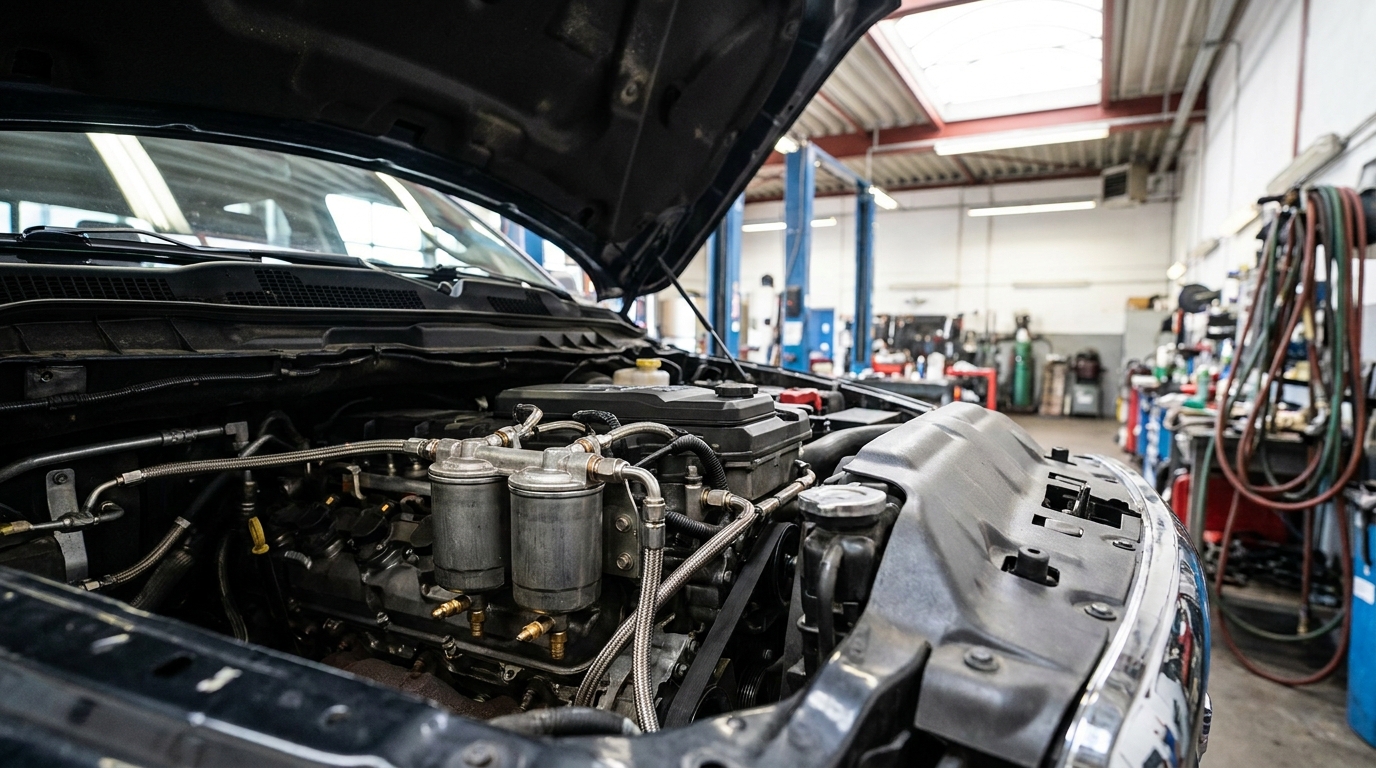
The schedule says "both engine mounted fuel filters", and on this truck that phrase is complete rather than partial. The 2026 owner's manual places them together: There are two engine mounted fuel filter assemblies mounted side-by-side on the driver side of the engine.[4]
Both are on the engine. So when the schedule calls for both engine mounted filters, it is asking for every fuel filter the truck has, and the whole job is done from the engine bay.
Why a figure from another document may not describe your truck
This is worth a section, because it is the reason a number found in a forum thread can be right and still not apply to you.
The 2024 Ram 2500 owner's manual opens with the same count: There are two fuel filter assemblies.[5]
Then it puts the second one somewhere the 2026 truck does not have one at all: one is on the under body, located in front of the rear axle above the drive shaft.[5]
The interval, by contrast, has held. Cummins' page for the Chassis Cab version of the same engine family publishes the figure the 2026 pickup handbook does, which is worth knowing when two documents disagree about the hardware: the number itself is corroborated across them.[2]
So the divergence to watch on these trucks is physical rather than numerical. A procedure, an access note or a parts list written for one model year is not automatically a fact about another, even where the interval and the count are identical. The schedule that governs your truck is the one printed for its model year and its body style.
Mileage is not the only trigger
The interval is the scheduled task. There is a second, unscheduled one that the truck asks for whenever it needs it: Drain the fuel/water separator filters when the Water In Fuel Indicator Light is ON.[4]
That is condition-driven rather than mileage-driven. Water collects when it collects, and the truck tells you. Draining is not a substitute for the scheduled replacement, and reaching the mileage does not mean you will not need to drain before you get there.
Buying the right parts for the change
Because both filters come out together, both go in together — and this is the step where the money gets wasted, because the two positions are not specified alike.
Ram names the part line first: We recommend using Mopar® Fuel Filters.[1]
Then it separates the positions. The forward one is the finer: Must meet 3 micron rating (front mounted filter).[1]
The other is not: Must meet 5 micron rating (rear engine mounted filter).[1]
Two filters, two ratings. Ordering a matched pair, or fitting them in the wrong positions, changes the filtration the fuel system was designed around, and the handbook states the cost of getting it wrong: Using a fuel filter that does not meet the manufacturer's filtration and water separating requirements can severely impact fuel system life and reliability.[1]
The short version
Both fuel filters, together, in the 15,000-mile row alongside the engine oil, and Cummins publishes the same interval on its own engine page.[1] Treat them as part of the oil service rather than as a separate job to diarise. The one exception is the early, indicator-prompted oil change, where the oil is due and the filter mileage is not — so the thing worth having on record is the odometer reading at the last filter change, not the last oil change. Buy a 3 micron filter for the front position and a 5 micron for the rear. Drain the separators whenever the water-in-fuel light asks, regardless of mileage. And check the layout against your own model year, because where the second filter sits has changed between them.
Sources
1. 2026 Ram 2500/3500 Owner's Handbook, maintenance schedule — Mopar vehicle information (Stellantis North America) 2. 2026 Ram 2500/3500 Owner's Manual — Mopar vehicle information (Stellantis North America) 3. 2024 Ram 2500 Owner's Manual — Mopar vehicle information (Stellantis North America) 4. Cummins Inc. — Cummins 6.7L Turbo Diesel (2021) and 6.7L Cummins Turbo Diesel (2019) for Chassis Cab engine pages
Sources & References
- Stellantis North America — Mopar vehicle information (Ram owner documentation) — 104749 67 DJD2 OH EN USC DIGITAL E3 — https://vehicleinfo.mopar.com/assets/publications/en-us-ca/2026/Ram/2500_3500/104749_67_DJD2_OH_EN_USC_DIGITAL_E3.pdf
- Cummins Inc. — 67l cummins turbo diesel 2019 chassis cab — https://www.cummins.com/engines/products/67l-cummins-turbo-diesel-2019-chassis-cab
- Cummins Inc. — Cummins 67l turbo diesel 2021 — https://www.cummins.com/engines/products/cummins-67l-turbo-diesel-2021
- Stellantis North America — Mopar vehicle information (Ram owner documentation) — 105361 67 DJD2 OM EN USC DIGITAL E4 — https://vehicleinfo.mopar.com/assets/publications/en-us-ca/2026/Ram/2500_3500/105361_67_DJD2_OM_EN_USC_DIGITAL_E4.pdf
- Stellantis North America — Mopar vehicle information (Ram owner documentation) — 103354 24 DJD2 OM EN USC DIGITAL E4 V1 — https://vehicleinfo.mopar.com/assets/publications/en-us/Ram/2024/2500/103354_24_DJD2_OM_EN_USC_DIGITAL_E4_V1.pdf
About this article
This article draws on 5 source(s) (citation tiers 2). 0 of 41 declared claims verified as SUPPORTED against frozen source spans. Citations follow the hyperlink-once convention: each source is linked once in the references below and referred to in short form thereafter.