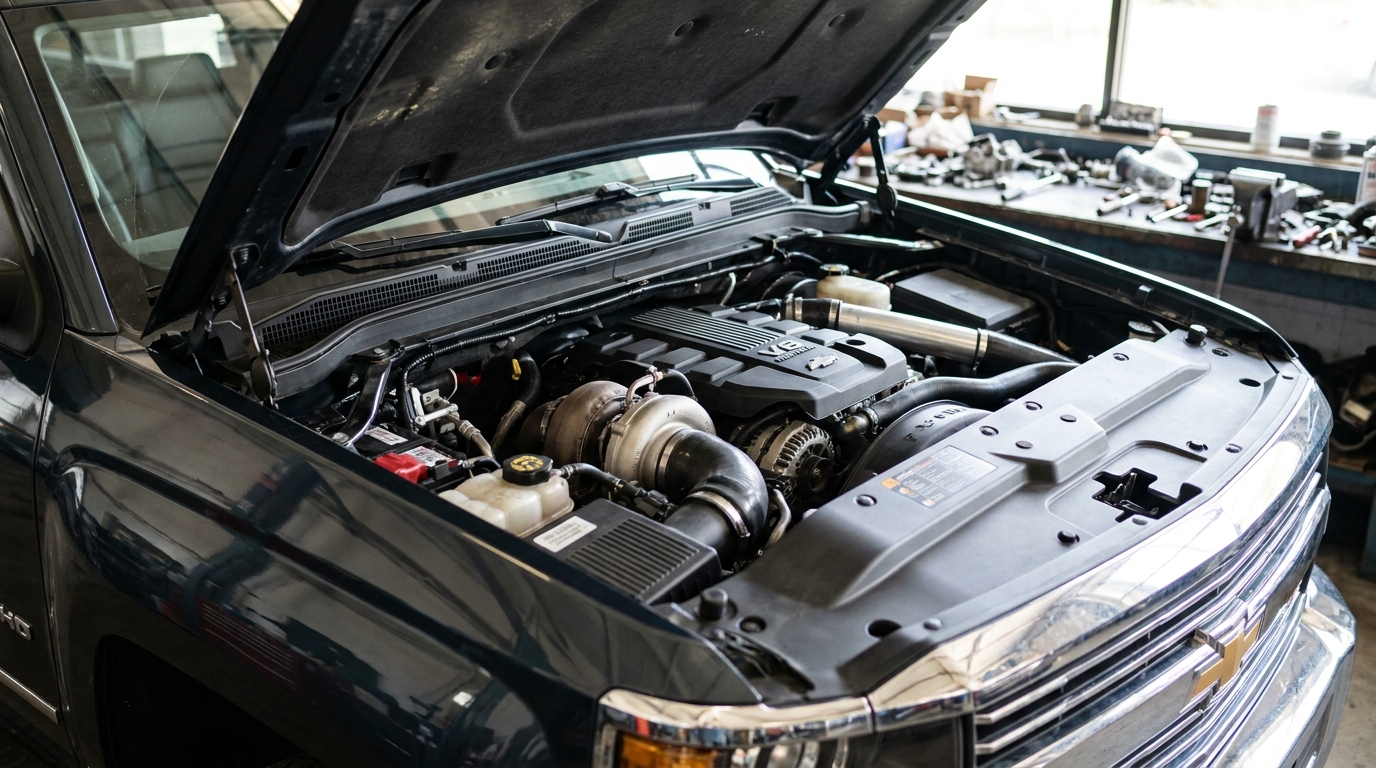
T1a · The Diesel Dudes
L5P CAN Bus Plugs: What They Are, Why the Model Year Matters, and What GM Says About Alterations
What a CAN bus is, mechanically
CAN stands for Controller Area Network. It is a communications standard that lets the control modules in a vehicle talk to each other over a shared pair of wires instead of running dedicated wiring between every module and every other module.
The practical picture: your engine control module, transmission control module, body control module, instrument cluster, ABS module and a dozen others are not independent computers. They are nodes on a network, continuously broadcasting and reading messages. The instrument cluster does not measure engine speed; it reads a message that the engine control module put on the bus. The transmission controller does not guess at engine load; it is told.
Two consequences follow, and both matter here.
The network is a shared dependency. A module that stops participating correctly does not fail quietly in its own corner. Its absence is noticed by every other module that expected its messages, which is why a single electrical fault on a modern truck can produce a dashboard full of warnings that appear unrelated to each other.
The network is terminated, not open-ended. A CAN bus is an electrical transmission line and needs correct termination at its ends to work reliably. Termination is the reason the word "plug" appears in this topic at all — a physical connector that completes or bridges part of the harness is doing an electrical job, not just occupying a hole.
That is the honest general description of the technology. What it does *not* tell you is where any specific connector sits on your truck, and this article is not going to invent that.
Why the L5P is a special case
The L5P generation introduced substantially heavier ECM security than the Duramax generations before it. In practice this is why the aftermarket treats the L5P differently from an LML or an LBZ: calibration work that was a plug-in operation on earlier trucks generally requires specialised physical ECM access or bench-level work on an L5P.
That single change reorganised everything downstream. It changed what tools exist, what they cost, what a shop can do in a bay versus what has to be sent away, and it changed the failure modes — because when access is harder, more of the work happens at the harness and connector level rather than in software.
It is also why the model year is not a detail on this platform. It is the first question.
2017–2019 and 2020–2023 are different jobs
Our own support documentation treats these as two separate procedures, with separate instructions for each: one covering the 2017-2019 L5P and one covering the 2020-2023 L5P.
They are not interchangeable. The reason to be emphatic about this is that the trucks look similar, the engine is called the same thing, and the parts are described with the same words — so the assumption that a procedure carries across is easy to make and expensive to act on.
If you take one thing from this article: establish whether your truck is in the 2017–2019 group or the 2020–2023 group *before* you order anything or start any work, and use the documentation for that group specifically.
Our support material is also explicit on one point that people try to skip: the can bus plugs must be installed. Where they are part of a documented procedure, leaving them out is not a shortcut that saves a step — it leaves the electrical job half-done, and the subsequent symptoms are usually blamed on something else entirely.
For the physical location and the step-by-step on your model-year group, the installation documentation in our help centre is the reference, and it is written by the technical team who handle these installs and the support tickets that follow them. A generic location description in an article like this one would be a guess dressed as a specification, and that is precisely the class of content this site is being rebuilt to stop publishing.
What General Motors says in writing about alterations
This is the section most people have not read, and it is short, quotable and worth taking seriously. It comes from GM's own upfitter documentation — the material GM publishes for companies that modify its vehicles professionally.
On warranty, GM's position is stated plainly: warranty does not cover any damage or failure resulting from modification or alteration to the vehicle's original equipment as manufactured or assembled by General Motors. GM's own examples of the alteration types not covered include installation or use of any non-GM part, accessory, materials, or the cutting, welding and similar operations on the vehicle.
On regulatory conformance, the same body of documentation is equally direct: no alteration should be made to the incomplete vehicle which either directly or indirectly results in any component, assembly or system being in nonconformance with any applicable Federal Motor Vehicle Safety Standard or Emission Regulation.
Read that second sentence carefully, because it does two things at once. It is GM telling professional upfitters that emissions conformance is their responsibility as well as GM's, and it uses the phrase "directly or indirectly" — which is to say the standard is about the resulting state of the vehicle, not about which specific component someone touched.
GM also publishes technical bulletins for upfitters as a faster channel than the annual body builder manuals, driven by things like a mid-year design change to the vehicle that affects upfitter modifications. That mid-year-change reality is another reason to work from documentation matched to your specific truck rather than to its nameplate.
The electrical discipline that prevents most of the problems
None of these depend on your model year and all of them prevent the most common outcomes we see in support tickets.
Disconnect the battery properly and give the modules time to power down. Working live on a CAN network risks more than a spark; it risks writing garbage to modules that are still awake.
Do not pierce insulation to test. Piercing probes leave a moisture path into a conductor inside a harness that lives under a hood through many heat cycles. The fault it creates appears months later and looks like an intermittent module failure.
Treat connector cleanliness as part of the job. A connector that is mechanically seated but corroded is an intermittent, and intermittents on a shared network produce symptoms that seem to point everywhere except the connector.
Change one thing at a time. On a network where modules depend on each other's messages, two simultaneous changes produce a symptom picture that cannot be attributed to either.
Read the codes before and after. A stored code from before your work is not evidence that your work caused it, and without a before-reading you cannot tell the difference.
Termination, in slightly more detail
The reason a CAN network is terminated at all is a signalling problem rather than a power one, and understanding it in outline makes several confusing symptoms make sense.
CAN signals travel as a voltage difference across a twisted pair of wires. Like any transmission line, that pair reflects signals back from an unterminated end, and reflections collide with the messages still arriving. The result is not a clean failure. It is corruption that gets worse with bus traffic and with cable length, which means it presents as intermittent, load-dependent misbehaviour rather than as a dead network.
Two properties follow that are worth carrying into any diagnosis:
A partially broken CAN network usually still works. Modules retry failed messages, so a degraded bus often functions until traffic rises. That is why symptoms can appear only under specific conditions and vanish when a technician goes looking for them.
Symptoms rarely point at the cause. A module that cannot get its messages through produces errors in the modules waiting on it. The warning appears where the information was expected, not where it went missing.
This is also why measuring the network's resistance across the pair is a standard first diagnostic step. It is a quick check of whether the physical layer is intact before anyone starts replacing modules, and a module replaced in response to a wiring fault reproduces the original symptom at considerably greater cost.
What a scan tool can and cannot tell you here
A generic OBD scan tool reads emissions-related diagnostic trouble codes. That is a narrow window on a truck of this complexity.
What it will show you: stored and pending emissions codes, freeze-frame data, and live sensor values from the modules that publish them on the standard channels.
What it generally will not show you: manufacturer-specific codes from body, chassis and network modules; communication-loss codes between specific module pairs, which are exactly the codes that matter for a bus problem; and the physical-layer condition of the network.
The practical consequence is that a truck can return "no codes" on a generic tool while carrying several network communication faults visible only to a tool with manufacturer-level coverage. "The scanner says it's fine" is a statement about the scanner's coverage as much as about the truck.
Before concluding that a network is healthy, confirm which modules the tool actually interrogated. A scan that never reached a module cannot report that module as clean, and a tool that reports no faults after failing to establish communication is describing its own silence.
Why "the manual for your truck" keeps being the answer
It would be more convenient if a single description covered every L5P, and the reason none does is visible in how GM itself distributes information.
GM publishes technical bulletins to upfitters as a faster channel than the annual body builder manuals precisely because the annual cycle is too slow. In GM's own description, the need for a technical bulletin may be driven by a mid-year design change to the vehicle that affects upfitter modifications, by information from a GM Service Bulletin that specifically affects upfitter modifications, or by frequent submissions involving one particular issue that many upfitters encounter.
Read that as a statement about the underlying reality: vehicles change within a model year, often enough that the manufacturer maintains a standing out-of-band channel for telling professionals about it. The body builder manuals themselves cover electrical schematics, body and frame dimensions and exhaust system modification, and GM positions them as material to be used in addition to the Incomplete Vehicle Document.
If GM needs a mid-year bulletin channel to keep professional upfitters current, a static article describing connector positions for "the L5P" is not going to be reliable for your specific truck. Documentation matched to the vehicle is not a cautious recommendation here; it is the only approach that survives contact with how these trucks are actually built and revised.
Legal notes — and these are not boilerplate on this topic
CAN bus plugs are discussed in the aftermarket in close proximity to emissions modification, so the legal position needs stating directly rather than in a footer.
Removing or disabling a factory emissions control system on a highway-registered vehicle violates 42 U.S.C. 7522(a)(3). This is a federal civil violation, and it is assessed on the resulting state of the vehicle. Civil penalties reach up to $5,911 per motor vehicle or engine for a person other than a manufacturer or dealer, and up to $59,114 per motor vehicle or engine for a manufacturer or dealer. Basis: 42 U.S.C. 7524, amounts per 40 CFR 19.4, assessed on or after 2025-01-08.[1]
Labelling a part "for off-road use only" does not create a legal exemption. The test is the vehicle's original certification, not where or how it is driven. The only use cases that are legally available are genuinely off-highway ones: closed-course competition, off-road-only equipment, and vehicles not registered for highway use.
Tampering with, removing or altering a factory emissions system gives the manufacturer immediate, legally protected grounds to void the powertrain and emissions warranties — and as quoted above, GM states its own version of that position in its own documentation.
For a registered truck, the compliant route to more capability is a part carrying a valid, part-specific CARB Executive Order number. An Executive Order is required for legal installation in California, and a part without one fails California Smog Check. Emissions-intact calibration and 50-state-legal hardware are the category that exists for street-registered vehicles.
Common questions
Are 2017-2019 and 2020-2023 L5P procedures the same? No. Our documentation covers them separately, and the model-year group is the first thing to establish.
Why does the L5P need specialised tooling when older Duramax trucks did not? The L5P generation introduced much stronger ECM security, which moved calibration work from a plug-in operation to one generally requiring specialised physical access.
Where exactly do the plugs go on my truck? Use the installation documentation for your model-year group. We deliberately do not publish a generic location, because it differs between the two groups and a wrong location sends you to the wrong harness.
Does GM's warranty language mean any modification voids everything? It means GM does not cover damage or failure resulting from the modification. The published language is specific about being tied to resulting damage or failure, and it is worth reading in full rather than in summary.
---
*Written by The Diesel Dudes Technical Team. Model-year-specific installation steps live in our help centre, written by the same team that handles these installs.*
Sources & References
- U.S. Environmental Protection Agency — Stopping Aftermarket Defeat Devices for Vehicles and Engines — https://www.epa.gov/enforcement/national-enforcement-and-compliance-initiative-stopping-aftermarket-defeat-devices
About this article
This article draws on 1 source(s) (citation tiers 1). 0 of 4 declared claims verified as SUPPORTED against frozen source spans. Citations follow the hyperlink-once convention: each source is linked once in the references below and referred to in short form thereafter.