T1a · The Diesel Dudes
How Many Cylinders in a 6.7 Cummins? Six, in a Single Row
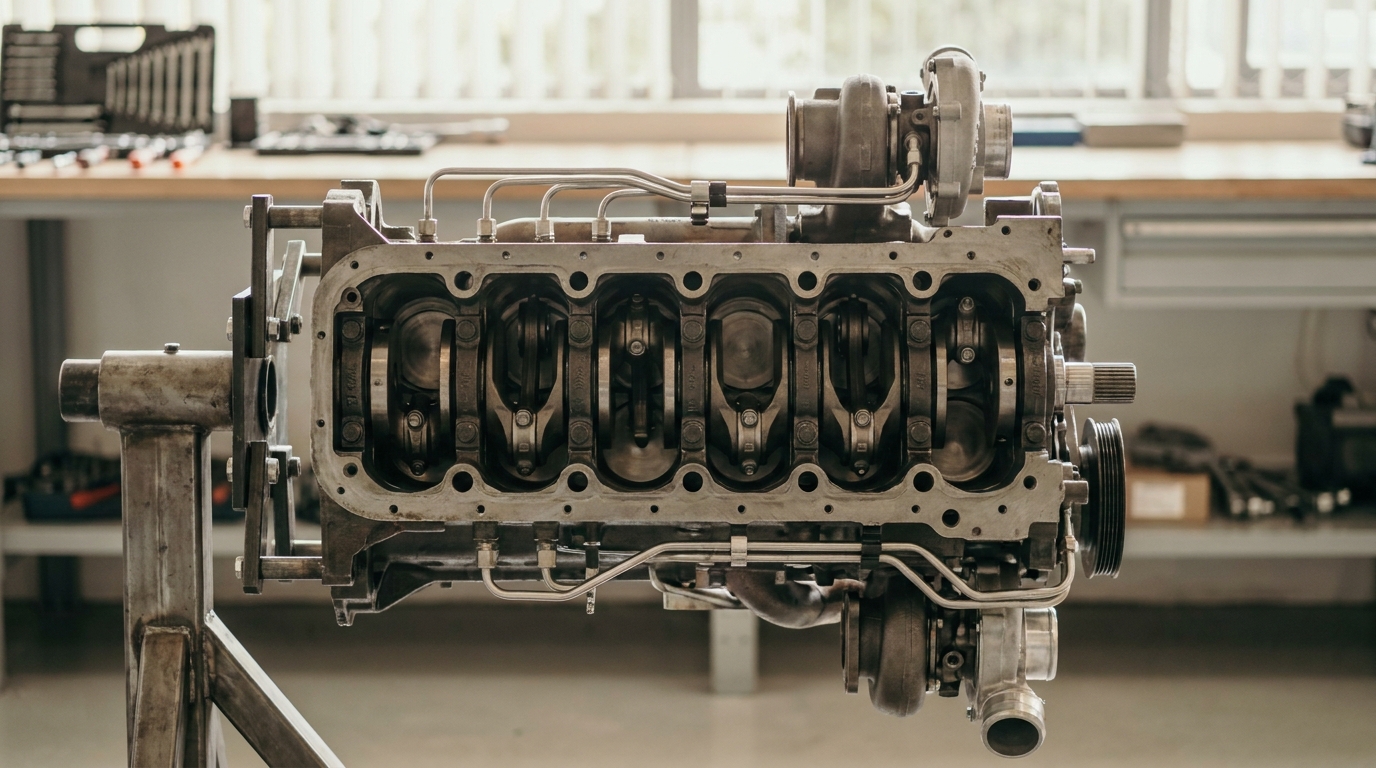
Six cylinders, in a single row
There is no need to work this out from displacement or to count injectors. Cummins publishes the answer in its own specification table for the 6.7L Turbo Diesel, where the number of cylinders is listed as six for both the high-output and the standard-output rating.[1]
Two ratings, one count. That matters, because the two ratings of this engine differ in several published respects and cylinder count is not one of them.
The specification table Cummins publishes for the 2019 chassis-cab version of the engine carries the same row.[2] So the count is a property of the engine family rather than of one truck, one transmission or one output level.
The layout, in the manufacturer's own words
Ram's introduction material for the engine states the layout outright and gives the displacement in cubic inches in the same sentence, describing the high-performance 408-cubic-inch inline-six intercooled turbo-diesel.[3]
Two useful things in one line. The layout is named, and the displacement appears in the unit American truck buyers grew up with: 408 cubic inches is the same volume as 6.7 litres, written the other way round.
Later Ram material drops the long form and calls it the Cummins I-6 Turbo Diesel instead.[5] The same abbreviation appears in Ram's material describing the torque milestone, which names the Cummins I-6 Turbo Diesel as the engine that reached it.[4]
"I-6" and "inline-six" are the same specification written two ways — the I stands for inline and the 6 is the cylinder count. If you are reading a spec sheet, a press release and a service manual for the same truck, you will meet both forms and occasionally the word "straight-six" as well. All three describe one arrangement.
Where the six cylinders come from arithmetically
Six cylinders on their own do not give you 6.7 litres. Two more published figures do that, and Cummins lists both.
Cummins publishes the bore as 107 mm for both ratings.[1] The published stroke is 124 mm, again for both ratings.[1]
Bore is how wide each cylinder is; stroke is how far the piston travels inside it. Multiply the area of one 107 mm circle by 124 mm of travel and you get the volume of one cylinder. Six of those is the displacement on the badge. Nothing about the number 6.7 is arbitrary — it is bore, stroke and cylinder count, and any two of those three plus the displacement will give you the third.
Notice the relationship between the two figures. The stroke, at 124 mm, is longer than the bore is wide. Engine people call that arrangement undersquare or long-stroke, and it is a deliberate choice for an engine whose job is pulling: a long stroke gives the expanding gas more leverage on the crankshaft, which is torque, and it does so at low engine speed.
Ram's introduction material publishes the 5.9-litre engine's bore and stroke next to the 6.7's, featuring a 107mm bore by 124mm stroke versus 102mm bore by 120mm stroke for the 5.9-liter engine.[3]
Both dimensions grew, and the cylinder count did not. That is the shortest possible summary of how the 5.9 became the 6.7 — the same six holes, each one wider and deeper.
Six cylinders, two very different ratings
Here is where the published table gets genuinely informative, and where "how many cylinders" stops being the useful question.
Cummins publishes two different compression ratios for the same six-cylinder block, listing the high-output engine at 16.2 to 1 and the standard-output engine at 19 to 1.[1]
That is a substantial difference inside identical cylinder dimensions. Compression ratio is how much the piston squeezes the air before fuel is injected, and lowering it on the high-output engine is what allows more fuel and more boost without exceeding what the cylinder and its head gasket can hold. The high-output engine is not a bigger engine. It is the same six cylinders working to a different set of numbers.
Which truck you can have it in is published too. The high-output rating is published as exclusive to one truck and one transmission, offered exclusively in the RAM 3500 equipped with the Aisin transmission option.[1]
So the output difference tracks the drivetrain behind the engine, not the engine's architecture. What the crankshaft can make and what the gearbox behind it can survive are two separate limits, and the rating is set by both.
Two things do not change between the ratings. Both ratings are published with the same fuel system in that table.[1] Both are also published with the same aspiration.[1]
One fuel system, one turbocharger arrangement, one cylinder count, two calibrations. If you have ever wondered why a standard-output truck and a high-output truck feel like relatives rather than different animals, that is why.
What holds six cylinders of this size together
An inline-six of nearly seven litres puts six large combustion events in a row along a single crankshaft, and the structure carrying them is not incidental to how long the engine lasts.
Cummins states that a Compacted Graphite Iron material for the block allows us to increase the cylinder pressure capability while reducing the overall weight by almost 60 lbs.[2]
Read that carefully, because it is two facts at once and both are about the block rather than the badge: a higher ceiling on what each cylinder can contain, and less iron doing the containing. Compacted graphite iron sits between ordinary grey cast iron and ductile iron in its behaviour, and the reason to choose it is stiffness per pound.
Even so, this is a heavy assembly. The published wet weight of the assembled engine is listed as 1,070 lbs for the high-output rating and 1,071 lbs for the standard-output rating.[1]
Over half a ton of engine, before the transmission. That figure explains a lot about how a heavy-duty truck is built around it — front axle rating, spring rates, steering effort and where the weight sits relative to the front wheels are all downstream of it.
The fuel side scaled with the structure. Cummins describes the fuel-delivery system on the 2019 engine as including a new 29,000 psi fuel pump and fuel rail.[2]
Common-rail pressures in that range are what allow a single injection event to be split into several precisely-timed ones, which is most of the reason a modern six-cylinder diesel is quieter and cleaner than the same layout was thirty years ago.
The inline-six goes back to the 5.9
The layout is not a recent decision. Ram's material records that in 1988, the Chrysler Group made a significant impact with the introduction of the Cummins 5.9-liter I-6 in heavy duty applications.[3]
Cummins dates the partnership from the 1989 model year, recording a 30-year partnership with RAM truck that started with the Cummins 5.9L Turbo Diesel in model year 1989.[1]
The two dates are not in conflict: one is when the engine entered the application, the other is the model year the trucks were sold as. Either way, the count has been six since the beginning.
The 6.7 was not a clean-sheet engine, and Ram published the overlap: the new engine retains more than 40 percent of its components from the 5.9-liter engine.[3]
Cummins traces the range of outputs from its 5.9-litre beginnings to the engines in current Ram pickups.[6] The output has multiplied. The number of cylinders has not moved once.
What six-in-a-row means when the engine is serviced
Cylinder count is not trivia in a service bay. It sets how many of several things you are dealing with.
Six cylinders in a line means one cylinder head, not two. One head gasket, one valve cover, one exhaust manifold run down one side, one camshaft, and a single row of injectors that can all be reached from above without lifting an intake manifold out of a valley first. Compare that with a V engine, where nearly every one of those becomes two, and half of them are buried.
The inline arrangement also cancels its own vibration in a way a V8 does not, because the firing events are evenly spaced and the reciprocating masses oppose each other in pairs. That is why heavy-duty diesels are so consistently inline-sixes: it is the layout that runs smoothly at low speed under load without needing a balance shaft to help it.
One traditional inline-six job was published as removed on the 2019 engine, where Hydraulic Lash Adjusters completely eliminate the need to adjust the overhead.[2] Setting valve lash on six cylinders was a scheduled job on older diesels of this layout, and a real reason people learned the firing order. On the current engine it is not on the list.
Cummins describes the current generation as a heavy-duty pickup engine built for serviceability alongside power and towing.[7] Serviceability being named at all is worth noticing, because on an inline-six a great deal of it comes directly from the layout: everything that needs regular attention is on one of two long sides.
If you are buying parts for this engine
Most people who look up the cylinder count are about to buy something — filters, a gasket set, injectors, or a part further out in the intake or exhaust. For anything in an emissions-related position, one rule decides whether the part is legal to fit to a road-registered truck, and it is worth knowing before the box arrives.
For an emissions-related part, the EPA states that CARB has issued an Executive Order that covers the same device or part on the same model vehicle on which the device or part was installed.[8] An Executive Order is therefore specific twice over: to the part, and to the vehicle it goes on. A number printed on a similar part for a different engine does not carry across.
The EPA states that it will typically find a reasonable basis for the conduct where the emissions-related element of design has been exempted by the California Air Resources Board.[9] That is the federal side of the same fact — an exemption issued in California is the recognised evidence that the part does not make emissions worse.
There is one category that can never obtain that exemption. CARB's own exemption procedures state that the Executive Officer shall deny the applicant's exemption request if the device will reduce the effectiveness of the emissions control system.[10] A part whose function is to reduce the effectiveness of an emissions control system sits outside the exemption route by definition, not merely awaiting approval.
The short version
Six cylinders, in one row, 107 mm across and 124 mm deep, in a compacted graphite iron block that weighs over a thousand pounds wet. Two published output ratings that differ in compression and calibration and not in cylinder count. The same six-in-a-row layout the engine has had since the 5.9, and the same reason heavy-duty diesels keep using it.
---
Sources
1. Cummins Inc., 6.7L Turbo Diesel (2021) engine specifications — https://www.cummins.com 2. Cummins Inc., 6.7L Turbo Diesel (2019) for Chassis Cab engine specifications — https://www.cummins.com 3. Cummins Inc., 6.7L Turbo Diesel Engine — https://www.cummins.com 4. Cummins Inc., Cummins-RAM History — https://www.cummins.com 5. Stellantis North America media newsroom, 6.7-litre Cummins introduction release — https://media.stellantisnorthamerica.com/newsrelease.do?id=6229&mid=97 6. Stellantis North America media newsroom, Ram Heavy Duty model-year press material — https://media.stellantisnorthamerica.com/newsrelease.do?id=21131 7. Stellantis North America media newsroom, Ram Heavy Duty model-year press material — https://media.stellantisnorthamerica.com/newsrelease.do?id=24053&mid=71 8. EPA, Tampering and Defeat Devices enforcement alert — https://www.epa.gov/sites/default/files/2020-12/documents/tamperinganddefeatdevices-enfalert.pdf 9. EPA, Enforcement Policy on Vehicle and Engine Tampering — https://www.epa.gov/sites/default/files/2020-12/documents/epatamperingpolicy-enforcementpolicyonvehicleandenginetampering.pdf 10. CARB, Procedures for Exemption of Add-On and Modified Parts — https://ww2.arb.ca.gov/sites/default/files/barcu/board/15day/ampts/proceduresfinal.pdf
Sources & References
- Cummins Inc. — Cummins 67l turbo diesel 2021 — https://www.cummins.com/engines/products/cummins-67l-turbo-diesel-2021
- Cummins Inc. — 67l cummins turbo diesel 2019 chassis cab — https://www.cummins.com/engines/products/67l-cummins-turbo-diesel-2019-chassis-cab
- Stellantis North America (Ram Trucks / Dodge) media newsroom — Newsrelease.do — https://media.stellantisnorthamerica.com/newsrelease.do?id=6229&mid=97
- Stellantis North America (Ram Trucks / Dodge) media newsroom — Newsrelease.do — https://media.stellantisnorthamerica.com/newsrelease.do?id=24053&mid=71
- Stellantis North America (Ram Trucks / Dodge) media newsroom — Newsrelease.do — https://media.stellantisnorthamerica.com/newsrelease.do?id=21131
- Cummins Inc. — Cummins ram history — https://www.cummins.com/engines/pickup-truck/cummins-ram-history
- Cummins Inc. — 67l engine ram 2500 and 3500 — https://www.cummins.com/engines/pickup-truck/67l-engine-ram-2500-and-3500
- US Environmental Protection Agency — Tamperinganddefeatdevices enfalert — https://www.epa.gov/sites/default/files/2020-12/documents/tamperinganddefeatdevices-enfalert.pdf
- US Environmental Protection Agency — Epatamperingpolicy enforcementpolicyonvehicleandenginetampering — https://www.epa.gov/sites/default/files/2020-12/documents/epatamperingpolicy-enforcementpolicyonvehicleandenginetampering.pdf
- The Diesel Dudes — Legal authorities index (internal, 24 primary sources) (internal editorial source — no outbound link)
About this article
This article draws on 10 source(s) (citation tiers 1, 2, 4). 0 of 24 declared claims verified as SUPPORTED against frozen source spans. Citations follow the hyperlink-once convention: each source is linked once in the references below and referred to in short form thereafter.