T1b · The Diesel Dudes
DPF Delete Software: What Regeneration Actually Does, and Where the Law Sits
Regeneration is automatic, and it starts earlier than most owners think
The first thing to know is that the truck cleans the filter by itself, well before any message appears.
When the Diesel Particulate Filter (DPF) is 40% full of particulate matter, the vehicle will look for opportunities to automatically enter regeneration mode, without alerting the driver or requiring any action.[1]
Read the end of that sentence carefully. At 40% the process is already running as conditions allow, with no message, no light, and nothing for the driver to do. Most owners never see this stage and have no reason to.
The four thresholds
What follows is an escalation, and each step has a published trigger.
At 70%, the truck asks for highway speed. If the filter has not managed to clear itself, the message arrives: reaches 70% full, the message "Exhaust Filter Nearing Full Safely Drive at Highway Speeds to Clear" will display at key-on and when the vehicle is in PARK.[1]
At 70% with the truck moving, regeneration is announced. If the DPF reaches 70% full, this message will display with a chime when the regeneration mode is automatically engaged while the vehicle is being driven at a suitable speed.[1]
Once that starts, the truck keeps reminding you until the job is finished: This will repeat every three minutes while the DPF is self-cleaning, until the particulate level is reduced to zero.[1]
At 90%, it needs three quarters of an hour. The time required is not fixed, and it scales with how loaded the filter is. The manual states the relationship first — The fuller the DPF is, the longer the regeneration process will take to complete. — and then puts a number on the heavily loaded case: if the DPF reaches 90%full, complete regeneration will typically require 45 minutes of driving to restore the system to normal operating condition.[1]
Forty-five minutes of driving. Not forty-five minutes of idling in a yard, and not three fifteen-minute trips.
At 100%, driving no longer helps. This is the threshold that turns a duty-cycle problem into a repair bill: This message displays if the DPF reaches 100% full.[1]
At that point the truck reduces power and the remedy leaves the owner's hands: regeneration is no longer possible and the vehicle should be taken to an authorized dealer[1]
And the filter itself is not necessarily the end of the cost: In extreme cases, a completely full DPF can damage the exhaust system, requiring part replacements.[1]
Why short trips are the actual fault
Here is the sentence that explains most of these cases, and it is in the manual rather than on a forum.
However, under conditions of exclusive short duration and low speed driving cycles, your Cummins® diesel engine and exhaust after-treatment system may never reach the conditions required to remove the trapped Particulate Matter (PM).[1]
"May never reach the conditions required" is a description of a duty cycle, not of a defect. A truck used for short low-speed journeys can accumulate soot faster than it gets the opportunity to burn it off, and the filter climbs through the thresholds above while every component works exactly as designed.
That is a genuinely fixable situation, and what fixes it is a periodic long run at road speed. A truck that gets one regularly tends never to see the 70% message at all.
There is also a version of the truck that can do it standing still. On equipped Chassis Cabs, a manual regeneration can be enable through the instrument cluster.[1] The manual regeneration will allow the DPF to complete a regeneration, lowering the soot level without having to drive the vehicle.
What the filter is part of
One more piece of context matters for the legal half, because the filter is not a standalone component.
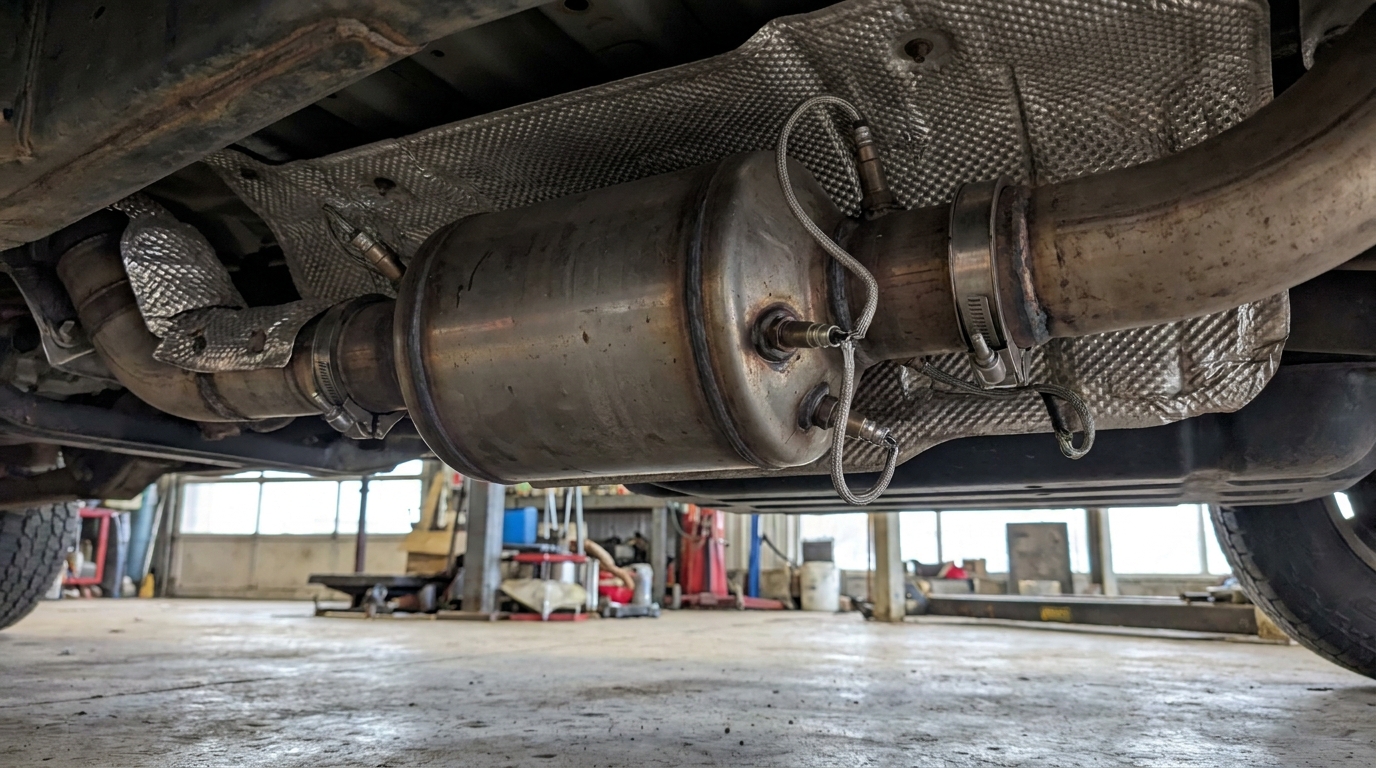
The truck uses an exhaust after-treatment system to reduce emissions utilizing a Diesel Particulate Filter (DPF) and a Selective Reduction Catalyst (SCR).[1]
A filter and a catalyst, working as one system. That is the object the law is written about.
Where delete software sits in federal law
Two separate prohibitions apply here, and delete software manages to sit inside both.
The first covers the hardware being deleted. Section 203(a)(3)(A) prohibits tampering with emissions controls, including those controls that are in the engine (e.g., fuel injection, exhaust gas recirculation), and those controls that are in the exhaust (e.g., filters and catalysts).[2]
The exhaust filter is named. There is no reading of that list under which a particulate filter is outside it.
The second covers the software. Section 203(a)(3)(B) prohibits aftermarket defeat devices.[2] This includes hardware (e.g., modified exhaust pipes) and software (e.g., engine tuners and tunes).
So software is inside the statute by name, not by analogy. EPA has also given the specific example: computer software that alters diesel fuel injection timing is a defeat device.[3]
And the prohibition reaches everyone in the chain rather than only the owner: The CAA prohibits tampering with emissions controls, as well as manufacturing, selling, and installing aftermarket devices intended to defeat those controls.[4]
Making, selling, installing, tampering. A shop that flashes the tune and a vendor that sells it are inside the same provision as the truck's owner.
The off-road label
Software in this category is almost always sold with an off-road or competition-only designation, and that designation is not a legal exemption for a truck that is registered and driven on public roads.
EPA addresses the conversion argument directly: The Clean Air Act does not contemplate removing emissions controls from an EPA-certified motor vehicle in order to convert it into a competition vehicle.[5]
There is no mechanism in the Act by which a certified highway truck becomes something else because parts came off it or because a calibration was changed. The label states what a seller intends by it.
Warranty
The consequence most owners meet first is contractual rather than regulatory.
Tampering, including installation of a defeat device, can void manufacturer warranties.[6]
EPA's other statement of it adds the causation element, which is the part worth knowing: Tampering can void manufacturer warranties and insurance agreements if the tampering can be shown to have caused the failure.[7]
So a modification in the after-treatment system's history is grounds to deny a later claim in that system, and whether it succeeds turns on the causal link. On duration, the answer is not the one most owners expect: prohibitions on tampering and defeat devices apply for the entire life of vehicles, engines, and equipment.[2] They apply regardless of whether the regulatory "useful life" or warranty period has ended.
A truck out of warranty is outside the manufacturer's obligation, and still inside the statute.
What the exposure is
Civil penalties for these violations are set by statute at 42 U.S.C. § 7524 and published in current form at 40 C.F.R. § 19.4, which adjusts them for inflation. Two amounts apply to two different classes of party, and the distinction between them is the detail most often reported the wrong way round.
For any person other than a manufacturer or dealer the figure is a maximum of $5,911 per motor vehicle or engine, described in the controlling authority as maximum, per motor vehicle or engine, for any person OTHER THAN a manufacturer or dealer under §7522(a)(3)(A); and for any person under §7522(a)(3)(B) per part or component[8]
For a manufacturer or dealer the figure is an order of magnitude higher, at a maximum of $59,114 per motor vehicle or engine, being the maximum, per motor vehicle or engine, for a MANUFACTURER OR DEALER under §7522(a)(3)(A)[8]
Both are ceilings rather than tariffs, and the statute directs how the actual number is arrived at: These are MAXIMA, not fixed amounts. §7524(b)-(c)(2) require the assessor to weigh gravity, economic benefit, business size and compliance history.[8]
Note also which measure attaches to software: the per-part-or-component measure under § 7522(a)(3)(B) carries the individual amount for any person, including a dealer.
The CARB Executive Order route, and why a delete cannot take it
There is a legitimate documented route by which an aftermarket part avoids enforcement, and it is worth knowing precisely because delete software cannot use it.
EPA lists a California Executive Order as one of the recognised ways to hold a reasonable basis: The California Air Resources Board (CARB) has issued an Executive Order (EO) that covers the same device or part on the same model vehicle on which the device or part was installed.[5]
That is a real path for a real category of parts. It is closed to this one by the terms on which such orders are granted: The Executive Officer shall deny the applicant's exemption request if the device will reduce the effectiveness of the emissions control system.[8]
A part whose function is to reduce the effectiveness of an emissions control cannot satisfy the test for the order that would exempt it. The category is excluded by definition rather than merely unapproved so far.
The honest summary
If your truck is showing filter-full messages, the first question is duty cycle, because the manual describes a cycle that automatic regeneration cannot complete on short low-speed journeys, and a sustained run is the documented remedy. That covers a great many of the trucks that arrive at this question.
For the trucks it does not cover: the particulate filter is named in the statute as an emissions control, the software is named as a defeat device, the prohibition reaches the seller and the installer alongside the owner, it lasts the life of the vehicle, and the off-road designation does not move any of it.
---
Legal notice
This article is educational and describes federal requirements as published by the EPA and the Code of Federal Regulations, alongside vehicle behaviour as published in Ram owner documentation. It is not legal advice.
Removing, disabling, bypassing or defeating an emissions control device on a vehicle certified for highway use is prohibited under the Clean Air Act, 42 U.S.C. § 7522(a)(3), and 40 C.F.R. § 1068.101(b). A diesel particulate filter is such a control, and calibration software that alters an emissions control element falls within § 7522(a)(3)(B) as an aftermarket defeat device. Civil penalties under 42 U.S.C. § 7524, as adjusted by 40 C.F.R. § 19.4 for violations assessed on or after 8 January 2025, reach a maximum of $5,911 per motor vehicle or engine for any person other than a manufacturer or dealer — and per part or component for any person, including a dealer, under § 7522(a)(3)(B) — and a maximum of $59,114 per motor vehicle or engine for a manufacturer or dealer. These are maxima rather than fixed amounts, and 42 U.S.C. § 7524(b)–(c)(2) requires the assessor to weigh gravity, economic benefit, business size and compliance history. These prohibitions apply for the entire life of the vehicle, regardless of whether the warranty or regulatory useful-life period has ended. A part or calibration labelled for off-road, competition or closed-course use is not a legal exemption for a vehicle that is registered or operated on public roads. A California Air Resources Board Executive Order cannot be issued for a device that reduces the effectiveness of an emissions control system.
Sources
1. 2026 Ram 2500/3500 Owner's Manual — Mopar vehicle information (Stellantis North America) 2. EPA, Enforcement Policy on Vehicle and Engine Tampering — https://www.epa.gov/sites/default/files/2020-12/documents/epatamperingpolicy-enforcementpolicyonvehicleandenginetampering.pdf 3. EPA, Tampering and Defeat Devices enforcement alert — https://www.epa.gov/sites/default/files/2020-12/documents/tamperinganddefeatdevices-enfalert.pdf 4. EPA, National Enforcement and Compliance Initiative: Stopping Aftermarket Defeat Devices — https://www.epa.gov/enforcement/national-enforcement-and-compliance-initiative-stopping-aftermarket-defeat-devices 5. EPA, Tampering and Aftermarket Defeat Devices (MCDI presentation) — https://www.epa.gov/sites/default/files/2019-05/documents/tampering-aftermarket-defeat-devices-2019-mcdi-mtg-33pp.pdf 6. EPA, Air Enforcement — https://www.epa.gov/enforcement/air-enforcement 7. Electronic Code of Federal Regulations, 40 C.F.R. § 19.4 — https://www.ecfr.gov/current/title-40/chapter-I/subchapter-A/part-19/section-19.4 8. EPA final rule, Civil Monetary Penalty Inflation Adjustment, 90 FR 1375 (8 January 2025) — https://www.govinfo.gov/content/pkg/FR-2025-01-08/pdf/2025-00206.pdf 9. CARB, Procedures for Exemption of Add-On and Modified Parts — https://ww2.arb.ca.gov/sites/default/files/barcu/board/15day/ampts/proceduresfinal.pdf
Sources & References
- Stellantis North America — Mopar vehicle information (Ram owner documentation) — 105361 67 DJD2 OM EN USC DIGITAL E4 — https://vehicleinfo.mopar.com/assets/publications/en-us-ca/2026/Ram/2500_3500/105361_67_DJD2_OM_EN_USC_DIGITAL_E4.pdf
- US Environmental Protection Agency — Epatamperingpolicy enforcementpolicyonvehicleandenginetampering — https://www.epa.gov/sites/default/files/2020-12/documents/epatamperingpolicy-enforcementpolicyonvehicleandenginetampering.pdf
- US Environmental Protection Agency — Air enforcement — https://www.epa.gov/enforcement/air-enforcement
- US Environmental Protection Agency — National enforcement and compliance initiative stopping aftermarket defeat devices — https://www.epa.gov/enforcement/national-enforcement-and-compliance-initiative-stopping-aftermarket-defeat-devices
- US Environmental Protection Agency — Tamperinganddefeatdevices enfalert — https://www.epa.gov/sites/default/files/2020-12/documents/tamperinganddefeatdevices-enfalert.pdf
- govinfo.gov — 42 U.S.C. § 7541 — Compliance by vehicles and engines in actual use (Clean Air Act §207; federal emission warranty) — https://www.govinfo.gov/content/pkg/USCODE-2021-title42/html/USCODE-2021-title42-chap85-subchapII-partA-sec7541.htm
- US Environmental Protection Agency — Tampering aftermarket defeat devices 2019 mcdi mtg 33pp — https://www.epa.gov/sites/default/files/2019-05/documents/tampering-aftermarket-defeat-devices-2019-mcdi-mtg-33pp.pdf
- The Diesel Dudes — Legal authorities index (internal, 24 primary sources) (internal editorial source — no outbound link)
About this article
This article draws on 8 source(s) (citation tiers 1, 2, 4). 1 of 25 declared claims verified as SUPPORTED against frozen source spans. Citations follow the hyperlink-once convention: each source is linked once in the references below and referred to in short form thereafter.