T1b · The Diesel Dudes
Is a DEF Delete Legal? What Federal Law Actually Says About Removing an SCR System
The short answer
The Clean Air Act prohibits tampering with emissions controls. The Environmental Protection Agency names them together as the prohibitions against tampering in section 203(a)(3) the Clean Air Act and 40 C.F.R. §§ 1068.101(b).[1]
Two things owners expect to change that answer do not change it. Age is one. EPA's tampering policy is explicit about it.
prohibitions on tampering and defeat devices apply for the entire life of vehicles, engines, and equipment.[2] They apply regardless of whether the regulatory "useful life" or warranty period has ended. A truck being out of warranty, or simply old, does not move it outside the statute.
The second is labelling, which gets its own section below, because "competition only" is the most common thing owners are told and the least accurate.
What the DEF system is actually doing on your truck
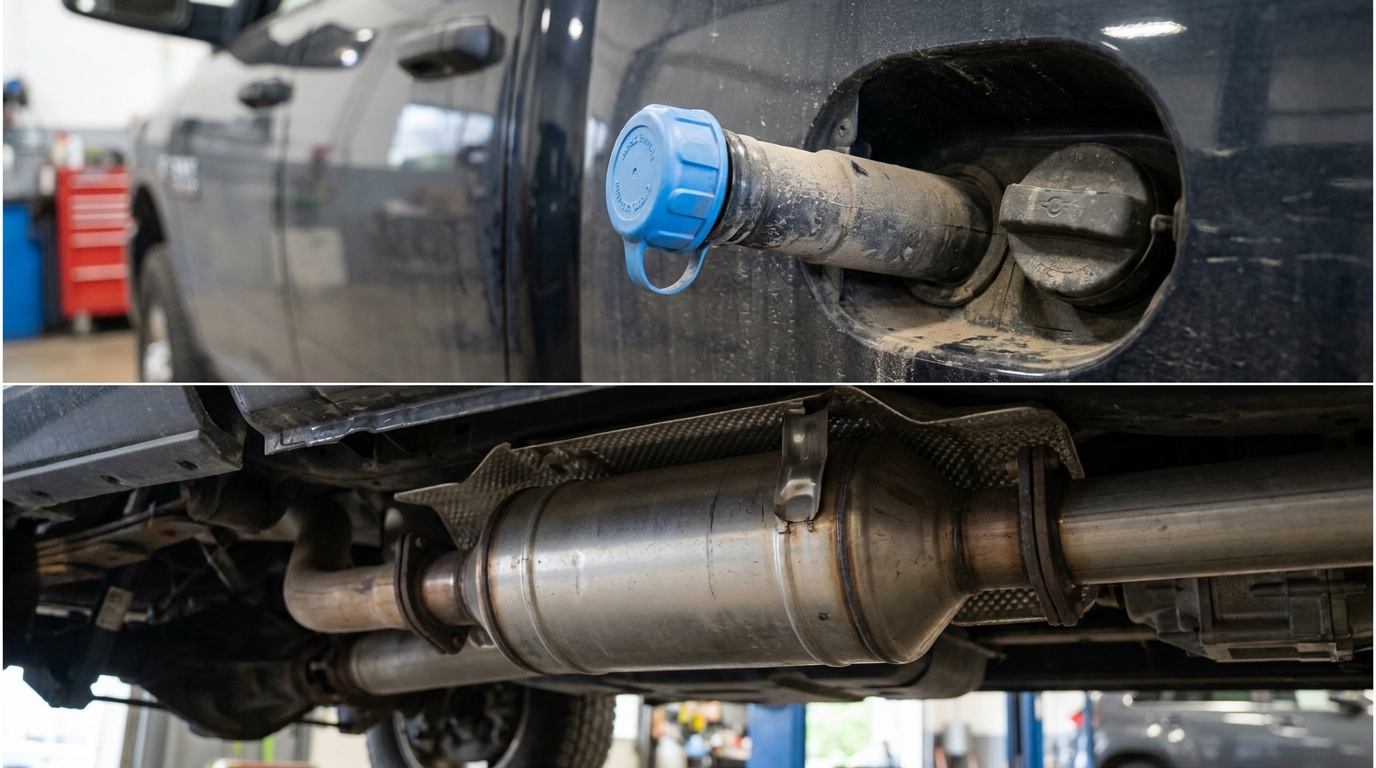
Diesel exhaust fluid is not an additive that improves how the engine runs. It is a reagent consumed by an aftertreatment process. In the Code of Federal Regulations, diesel exhaust fluid (DEF) means a liquid reducing agent (other than the engine fuel) used in conjunction with selective catalytic reduction to reduce NO X emissions.[3]
That process has been near-universal on this class of vehicle for some time. Since 2010, nearly all on-road diesel trucks and many types of nonroad equipment (such as tractors and construction machinery) have used DEF as part of selective catalytic reduction systems to reduce emissions of nitrogen oxides, a major contributor to air quality nonattainment.[4]
Two design requirements matter for understanding why a delete is not a simple subtraction. First, the vehicle has to watch itself. On-Board Diagnostics: Vehicles must have OBD to monitor the SCR system to detect low-DEF levels, system failures, and alert the driver via a warning light.[4] Second, the system is required to defend itself. Tamper Prevention System: The system must be designed to prevent tampering or bypassing DEF usage.[4]
The behaviour owners actually complain about is the third piece, and it comes from the same monitoring. EPA acknowledges it plainly.
These systems can force a vehicle to drastically reduce speed or become inoperable if DEF runs out or if system sensors fail.[4] The derate that strands a truck and the diagnostics that report a fault are not two systems in conflict. They are one system doing what it was certified to do.
What federal law prohibits
The prohibition is broader than removing a part. The CAA prohibits tampering with emissions controls, as well as manufacturing, selling, and installing aftermarket devices intended to defeat those controls.[5] Elsewhere the Agency is broader still.
The CAA prohibits anyone from tampering with an emission control device on a motor vehicle by removing it or making it inoperable prior to or after the sale or delivery to the buyer.[6] Four distinct activities are covered — making, selling, installing, and the act of tampering itself — and the timing relative to sale is explicitly irrelevant.
The test EPA applies is a comparison, not a judgement about intent. EPA's stated method is a comparison.
When determining whether service performed on an element of an emission control system was illegal tampering, the EPA typically compares the element after the service to the element's fully- functioning certified configuration.[7] The certified configuration is the reference. Anything measured against it either matches or does not.
Software sits inside the same boundary, which surprises people who assume only hardware counts. EPA's guidance draws the line this way.
If on the other hand, the part modulates or controls an element of the emission control system, such as altering how the computer controls the fuel, then it would be a defeat device.[7] A tune written to suit absent aftertreatment is describing itself.
For completeness on scope, the reach is wide.
EPA regulations apply to virtually every vehicle, engine and gallon of transportation fuel.[8]
And the standard a given truck was built to is not optional either: Emissions Limit Requirements: Vehicles must effectively meet EPA Tier 2, Tier 4, or 2010 emissions standards, depending on the vehicle type and model year.[4] Which standard applies to a given truck varies. Whether a standard applies is not the variable.
Why the recent EPA derate guidance is not permission to delete
This is the section most worth reading carefully, because a real EPA action has been widely repeated as something it is not.
The action is real. Specifically, EPA is issuing guidance to manufacturers for how they may modify DEF systems on new and existing diesel vehicles and nonroad equipment to reduce derates that can limit a vehicles performance to nearly inoperable levels (as low as five miles per hour).[4] The Agency is not defending the five-mile-per-hour outcome. It is addressing it.
Three details in EPA's own description determine what the guidance means for an owner.
It is addressed to manufacturers, not to owners or shops.
EPA is urging engine and equipment manufacturers to follow this guidance and develop software updates that align with the Agency's recommendations.[4] The recipient of the instruction is the manufacturer.
It is voluntary because of a limit on EPA's authority, not because the underlying rules were relaxed. These are the Agency's own words.
By law, EPA cannot mandate field fixes for in-use vehicles and nonroad equipment, which is why the Agency is issuing voluntary guidance to manufacturers on system modifications to reduce derates.[4] That sentence is frequently quoted as evidence that nothing is enforceable. It says something narrower — it explains why a *fix* cannot be compelled, and it says nothing about the tampering prohibitions, which are statutory.
The remedy it points to is a software update, not a removal.
This includes developing software updates for in-use vehicles that extend the time available to resolve certain SCR-related issues that trigger inducements (e.g., DEF quality or tampering).[4] More time to resolve a fault is a different thing from permission to eliminate the subsystem that reports it.
The wider regulatory direction points the same way rather than toward relaxation. In 2022, EPA finalized a revised inducement strategy, starting with model year 2027 heavy-duty on-highway vehicles and engines.[4] Earlier, in 2014, EPA issued a Final Rule for Emergency Vehicles which included Selective Catalytic Reduction Maintenance and Regulatory Flexibility for Nonroad Equipment.[4] Inducement strategy has been revisited more than once. It has been revisited, not withdrawn.
"Competition only" and off-road labels
An off-road or competition-only designation on a part is not a legal exemption for a vehicle that is registered and driven on public roads. EPA's position on the conversion argument is direct.
The Clean Air Act does not contemplate removing emissions controls from an EPA-certified motor vehicle in order to convert it into a competition vehicle.[1] The Act does not describe a route by which a certified highway vehicle becomes an uncertified competition vehicle by having parts taken off it.
EPA has also said what it found when it examined the claim in practice. EPA has said what it found when it examined the claim.
The EPA has found that many companies that make and sell aftermarket defeat devices claim "competition only" use but cannot provide any information to show that their products are used solely in competition motorsports.[1] And the Agency has described the scale.
Recent EPA investigations have revealed evidence showing that hundreds of thousands of diesel pickup trucks have had their emissions controls completely removed, and most or all the aftermarket defeat devices used to tamper these trucks were sold under the claim of "competition only."[1]
That is the practical significance of the label. It is a description of intended use printed by a seller. It is not a finding by any agency about the vehicle it ends up on.
Warranty, and the useful-life question
Emissions warranties are a statutory obligation on the manufacturer. The Act requires OEMs to provide emission-related warranties for their products.[2] The citation is CAA § 207, 42 U.S.C. § 7541.
Tampering puts that coverage at risk, and the mechanism differs depending on which document you read. EPA's enforcement alert states it plainly.
Tampering, including installation of a defeat device, can void manufacturer warranties.[9] Its tampering policy adds a causation element for the insurance and failure case.
Tampering can void manufacturer warranties and insurance agreements if the tampering can be shown to have caused the failure.[7] Both are worth knowing, because they are different tests, and the second is the one that tends to matter after a component has actually failed.
The useful-life point from the opening bears repeating here, because this is where the warranty question and the legal question are most often confused. Warranty expiry changes what the manufacturer owes. It does not change what the statute prohibits.
What the exposure is
Civil penalties under the Clean Air Act are set by statute at 42 U.S.C. § 7524 and the current amounts are published in 40 C.F.R. § 19.4, which adjusts under the Federal Civil Penalties Inflation Adjustment Act. The figures below are read from that regulation rather than from a summary page, because several EPA landing pages still display superseded amounts.
Two amounts apply to two different classes of party, and this distinction is the part most often reported wrongly:
- A maximum of $5,911 — for any person *other than* a manufacturer or dealer, per motor vehicle or engine under § 7522(a)(3)(A); and for any person, including a dealer, per part or component under § 7522(a)(3)(B). - A maximum of $59,114 — for a manufacturer or dealer, per motor vehicle or engine under § 7522(a)(3)(A).
Both amounts are per 40 C.F.R. § 19.4, for violations assessed on or after 8 January 2025, and they are the operative figures at the time of writing.
The enforcement posture behind those numbers is a matter of public record. By making aftermarket defeat devices a National Enforcement and Compliance Initiative (NECI), EPA addressed a significant contributor to air pollution.[5] According to a study by EPA's Air Enforcement Division, known sales of defeat devices for certain diesel trucks after 2009 and before 2020 resulted in more than 570,000 tons of excess nitrogen oxides.[5] As a result of EPA enforcement, some of the largest manufacturers of defeat devices have agreed to pay penalties and stop the sale of defeat devices.[6] EPA has also stated the consequence for a business directly.
installing a defeat device or tampering with a motor vehicle or non-road equipment can be costly to their businesses and can subject them to enforcement and penalties.[1]
State activity runs alongside this rather than instead of it. States' efforts to curtail the demand for aftermarket defeat devices complement the EPA's efforts, which are generally focused on the manufacturing and supply of aftermarket defeat devices.[5] Federal supply-side enforcement and state demand-side rules are two layers, and an owner can be within reach of both.
The compliant path when your truck is derating
If a truck is in a DEF-related derate, there is a route that addresses the problem without putting the vehicle outside the statute. It is the route EPA itself is pushing.
Start with the manufacturer software update. This is the substance of the recent guidance: EPA is urging manufacturers to develop software updates for in-use vehicles that extend the time available to resolve SCR-related issues that trigger inducements. Where an update exists for a given engine, it is the intended answer to the derate.
Diagnose rather than assume. Because the system derates on low DEF level, on DEF quality, and on sensor failure, the correct first question is which of those the vehicle is actually reporting. A fluid-quality problem and a failed sensor produce a similar symptom and do not have the same repair.
Restoration is explicitly protected. This is the one route the guidance names.
Where a person is asked to perform service on an element of an emission control system that has already been tampered, the EPA will generally take no enforcement action if the person restores the element to its certified configuration.[7] Returning a truck to certified configuration is the one path the guidance names as generally safe from enforcement.
Where aftermarket parts are appropriate, the compliant categories are defined. For a vehicle registered for road use, the legal route runs through parts carrying a California Air Resources Board Executive Order, parts certified through recognised emissions-compliant programmes, emissions-intact tuning that does not modulate an emissions control element, and OEM restoration. That is a real and reasonably large category of work. It is bounded by the same test as everything else in this article: the certified configuration stays intact.
None of this makes a derate less frustrating. It does mean the frustrating version and the unlawful version are not the only two options.
---
Legal notice
This article is educational and describes federal requirements as published by the EPA and the Code of Federal Regulations. It is not legal advice.
Removing, disabling, bypassing or defeating an emissions control device on a vehicle certified for highway use is prohibited under the Clean Air Act, 42 U.S.C. § 7522(a)(3), and 40 C.F.R. § 1068.101(b). Civil penalties under 42 U.S.C. § 7524, as adjusted by 40 C.F.R. § 19.4 for violations assessed on or after 8 January 2025, reach a maximum of $5,911 per motor vehicle or engine for any person other than a manufacturer or dealer — and per part or component for any person under § 7522(a)(3)(B) — and a maximum of $59,114 per motor vehicle or engine for a manufacturer or dealer. These are maxima rather than fixed amounts: 42 U.S.C. § 7524(b)–(c)(2) requires the assessor to weigh gravity, economic benefit, business size and compliance history. These prohibitions apply for the entire life of the vehicle and apply regardless of whether the warranty or regulatory useful-life period has ended. A part labelled for off-road, competition or closed-course use does not create an exemption for a vehicle that is registered or operated on public roads.
Sources
1. Electronic Code of Federal Regulations, 40 C.F.R. Part 86 — https://www.ecfr.gov/current/title-40/chapter-I/subchapter-C/part-86 2. Electronic Code of Federal Regulations, 40 C.F.R. Part 1068 — https://www.ecfr.gov/current/title-40/chapter-I/subchapter-U/part-1068 3. Electronic Code of Federal Regulations, 40 C.F.R. § 19.4 — https://www.ecfr.gov/current/title-40/chapter-I/subchapter-A/part-19/section-19.4 4. EPA, Diesel Exhaust Fluid — https://www.epa.gov/regulations-emissions-vehicles-and-engines/diesel-exhaust-fluid 5. EPA, National Enforcement and Compliance Initiative: Stopping Aftermarket Defeat Devices — https://www.epa.gov/enforcement/national-enforcement-and-compliance-initiative-stopping-aftermarket-defeat-devices 6. EPA, Tampering and Defeat Devices enforcement alert — https://www.epa.gov/sites/default/files/2020-12/documents/tamperinganddefeatdevices-enfalert.pdf 7. EPA, Enforcement Policy on Vehicle and Engine Tampering — https://www.epa.gov/sites/default/files/2020-12/documents/epatamperingpolicy-enforcementpolicyonvehicleandenginetampering.pdf 8. EPA, Tampering and Aftermarket Defeat Devices (2019 MCDI presentation) — https://www.epa.gov/sites/default/files/2019-05/documents/tampering-aftermarket-defeat-devices-2019-mcdi-mtg-33pp.pdf 9. EPA, Air Enforcement — https://www.epa.gov/enforcement/air-enforcement 10. EPA, Overview of Certification and Compliance for Vehicles and Engines — https://www.epa.gov/ve-certification/overview-certification-and-compliance-vehicles-and-engines 11. 40 C.F.R. § 1068.101, Cornell Law School Legal Information Institute — https://www.law.cornell.edu/cfr/text/40/1068.101 12. EPA final rule, Civil Monetary Penalty Inflation Adjustment (8 January 2025) — https://www.federalregister.gov/documents/2025/01/08/2025-00206/civil-monetary-penalty-inflation-adjustment
Sources & References
- US Environmental Protection Agency — Tamperinganddefeatdevices enfalert — https://www.epa.gov/sites/default/files/2020-12/documents/tamperinganddefeatdevices-enfalert.pdf
- US Environmental Protection Agency — Epatamperingpolicy enforcementpolicyonvehicleandenginetampering — https://www.epa.gov/sites/default/files/2020-12/documents/epatamperingpolicy-enforcementpolicyonvehicleandenginetampering.pdf
- US Government Publishing Office — Electronic Code of Federal Regulations — Part 86 — https://www.ecfr.gov/current/title-40/chapter-I/subchapter-C/part-86
- US Environmental Protection Agency — Diesel exhaust fluid — https://www.epa.gov/regulations-emissions-vehicles-and-engines/diesel-exhaust-fluid
- US Environmental Protection Agency — National enforcement and compliance initiative stopping aftermarket defeat devices — https://www.epa.gov/enforcement/national-enforcement-and-compliance-initiative-stopping-aftermarket-defeat-devices
- US Environmental Protection Agency — Air enforcement — https://www.epa.gov/enforcement/air-enforcement
- US Environmental Protection Agency — Tampering aftermarket defeat devices 2019 mcdi mtg 33pp — https://www.epa.gov/sites/default/files/2019-05/documents/tampering-aftermarket-defeat-devices-2019-mcdi-mtg-33pp.pdf
- US Environmental Protection Agency — Overview certification and compliance vehicles and engines — https://www.epa.gov/ve-certification/overview-certification-and-compliance-vehicles-and-engines
- govinfo.gov — 42 U.S.C. § 7541 — Compliance by vehicles and engines in actual use (Clean Air Act §207; federal emission warranty) — https://www.govinfo.gov/content/pkg/USCODE-2021-title42/html/USCODE-2021-title42-chap85-subchapII-partA-sec7541.htm
About this article
This article draws on 9 source(s) (citation tiers 1). 1 of 31 declared claims verified as SUPPORTED against frozen source spans. Citations follow the hyperlink-once convention: each source is linked once in the references below and referred to in short form thereafter.