T1b · The Diesel Dudes
Can You Delete a 2026 Cummins? The Answer, and What Is On the Truck
The answer
No, not on a truck registered for road use. The Environmental Protection Agency names the prohibitions on tampering as Clean Air Act section 203(a)(3) and 40 C.F.R. §§ 1068.101(b).[2] The Clean Air Act prohibits anyone from tampering with an emission control device on a motor vehicle by removing it or making it inoperable, whether before or after the sale to the buyer.[1]
Because the truck is new, two follow-up questions usually come next. Does being under warranty change it, and does the age of the rules matter? Neither does. Those prohibitions apply for the entire life of the vehicle, and they apply regardless of whether the regulatory useful life or the warranty period has ended.[3]
The rest of this article is the part that is actually specific to a 2026 truck: what the emissions system on it is, what it does that owners notice, and what the compliant options are. Treat it as a technical and legal reference; it is not legal advice about your own truck.
What the 2026 truck has
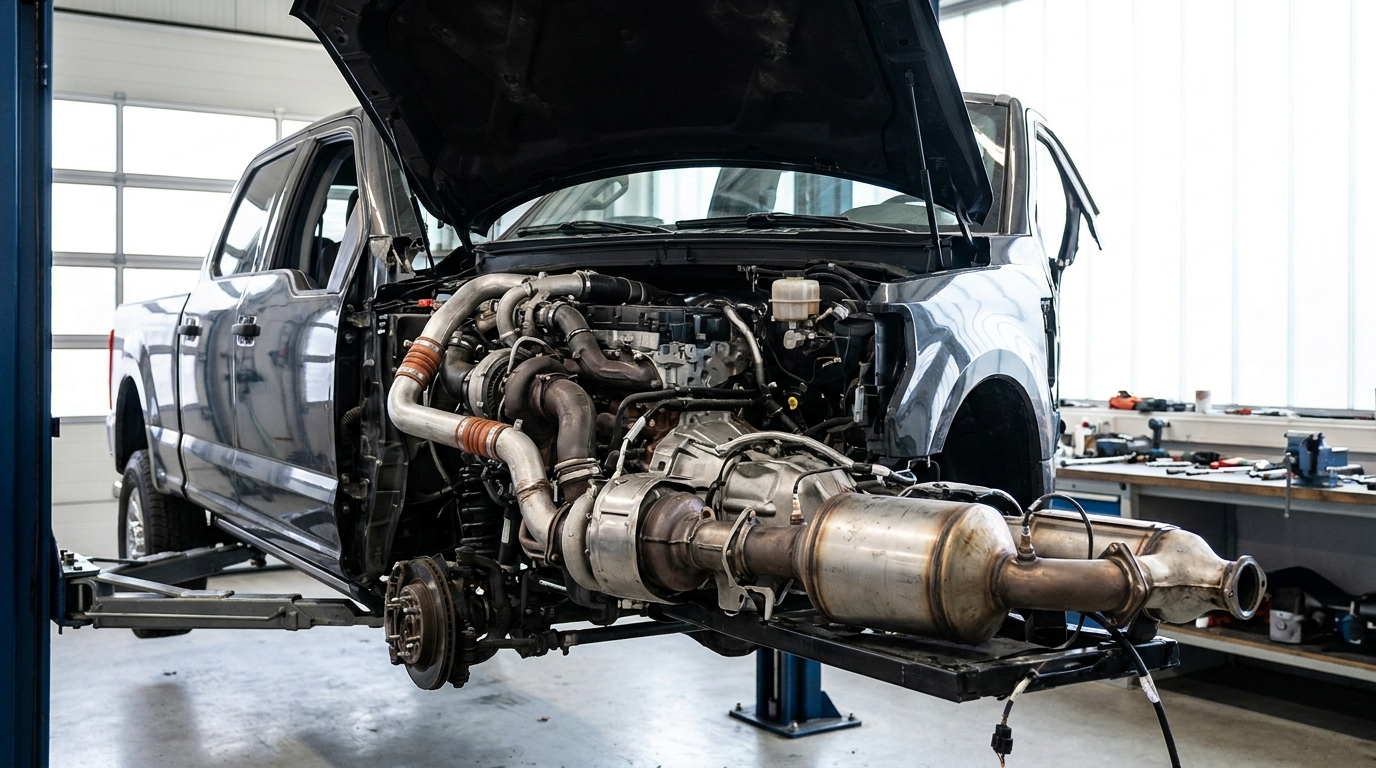
The current Ram Heavy Duty carries two things worth naming precisely, because the second is usually what people mean when they say delete. The truck is equipped with a Diesel Exhaust Fluid injection system and a Selective Catalytic Reduction catalyst to meet the emission requirements.[4] Separately, the manual states that the truck is equipped with a Selective Catalytic Reduction system to meet the very stringent diesel emissions standards required by the Environmental Protection Agency.[4]
The purpose of that system is to reduce oxides of nitrogen to a near-zero level.[4] The mechanism is chemical rather than mechanical, and the manual sets it out plainly.
A small quantity of Diesel Exhaust Fluid is injected into the exhaust upstream of a catalyst where, when vaporized, it converts smog-forming nitrogen oxides into harmless nitrogen and water vapor, two natural components of the air we breathe.[4] Diesel exhaust fluid, sometimes known simply by the name of its active component urea, is a key component of Selective Catalytic Reduction systems, which help diesel vehicles meet stringent emission regulations.[4]
That is the whole of it: a tank of urea solution, a pump, an injector and a catalyst. It is not a restriction added to the exhaust, and it does not work by limiting anything the engine does.
The manual also names the pair of devices together, which is worth holding onto, because the two get discussed as though they were one part. The manual describes the after-treatment system as using a Diesel Particulate Filter and a Selective Reduction Catalyst to reduce emissions.[4] DEF is injected directly into the SCR through a dosing module.[4] One traps soot; the other converts oxides of nitrogen using a fluid that is metered in.
What the DEF system does that owners notice
This section is here because most of the things that send owners of new trucks looking for a delete are documented in the manual as normal operation. They are worth reading in the manufacturer's own words, because the same behaviour reads as a fault if nobody tells you it is expected.
The pump keeps working after you switch off.
The DEF pump will run for a period of time after engine shutdown to purge the DEF system.[4]
There is a clicking noise, and it is the fluid being metered in.
You may occasionally hear an audible clicking noise.[4] That injection process creates a clicking sound and at times will make noise even with the vehicle shut off.[4] The manual records that noise as normal, and as the dosing module purging DEF.[4]
There is a second clicking sound with a different cause, and telling them apart is useful. A clicking sound from under the hood shortly after shutdown is also normal, as actuators such as the EGR valve are cycled.[4] Neither is a fault, and neither is the sound of anything wearing out.
The tank has a heater, and freezing is planned for.
There is an electric heater inside the DEF tank that automatically works when necessary.[4] For example, DEF may freeze at temperatures at or below 12°F.[4] If the DEF supply does freeze, the truck will operate normally until it thaws.[4]
That last sentence is the one most worth knowing before a cold morning. A frozen tank is not a breakdown and it is not a reason to reach for anything; the system is designed around it.
The gauge does not behave like a fuel gauge.
In cold conditions of 12°F (-11°C) and below, the DEF gauge needle can stay in a fixed position and may not move for extended periods of time.[4] The DEF gauge may also not immediately update after a refill if the temperature of the fluid is below 39°F (4°C).[4] The DEF tank heater will warm the fluid and allow the gauge to update after a period of run time.[4] At 40°F (4°C) you could see some increase in the DEF gauge, because the tank is thawing.[4]
Read together, those four lines account for almost every complaint about a DEF gauge: a needle that will not move in the cold, a refill that does not register, and a level that seems to climb on its own as the day warms up. All three are the documented behaviour of a heated tank with a level sensor in it.
There is one more reason the needle sits still, and it has nothing to do with temperature. The DEF tank on these vehicles is designed with a large amount of full reserve.[4] So the level sensor will indicate a full reading even before the tank is completely full.[4] So a gauge that has not moved after a long trip may be reporting a tank that is still above the point where the sensor begins to register a change.
One cold-weather caution belongs with the refill advice rather than with the gauge. If the tank is overfilled and freezes, it could be damaged.[4] Topping a tank to the brim before a hard freeze is the one filling habit the manual warns against.
A fault in the gauge announces itself differently from a low tank.
If something is wrong with the gauge itself, a DEF Warning Message or the Malfunction Indicator Light will be displayed.[4]
That distinction matters more than it sounds. A low tank produces a level warning and a countdown; a gauge or system fault produces a warning message or the malfunction indicator light. The two look similar on a dashboard and they have different repairs, so an owner who treats every DEF message as a failing system will end up paying to replace something that was working.
Consumption is not a fixed rate.
Driving conditions such as altitude, vehicle speed and load will affect the amount of DEF that is used in your vehicle.[4]
So a truck towing at altitude will use fluid at a different rate from the same truck running empty on the flat, and a gauge dropping faster than last month is not evidence of a leak.
Two handling facts are worth knowing alongside those. If DEF is kept in temperatures between 10°F and 90°F, it will last a minimum of one year.[4] Any containers or parts that come into contact with DEF must be DEF compatible, meaning plastic or stainless steel, because copper, brass, aluminium and non-stainless steel corrode in contact with the fluid.[4]
Some of the noise is the engine, not the emissions system.
The manual treats engine sound as its own subject, and it is worth separating from anything the after-treatment system does. Diesel engines can create noises that may seem concerning.[4] Clicking, ticking or light knocking is normal and will change from day to day, as the engine breaks in, and can vary with changes in ambient temperature.[4] Weather, barometric pressure, altitude and temperature will affect how fuel is ignited in the engine.[4] Fuel pump noise may increase during low speed and light load conditions when the ambient temperature is above 100°F (38°C), and when the fuel tank level is below 10%, which is a normal condition of the fuel system and controls strategy.[4]
An owner who has decided the emissions hardware is the problem will hear all of that as confirmation. The manual attributes it to combustion, the weather and the fuel system, none of which a delete touches.
Why that matters for a delete
Put the lists next to each other and the practical point emerges. A noise after shutdown, a needle that does not move, a gauge that ignores a refill in the cold and a fluid that thickens in winter are all in the manual as expected behaviour. They are not evidence of a system failing, and they are not the problem a delete would solve.
Where a fault is real, it is worth diagnosing which part of the system is reporting it, because fluid quality, fluid level and a sensor produce similar symptoms and do not share a repair.
What federal law prohibits
The prohibition reaches past the parts you can lift off the truck, and the test the agency applies is a comparison. When EPA decides whether service on an emissions element was tampering, it compares the element after the service against its fully functioning certified configuration.[5]
Everything is measured against the configuration the truck was certified in. That is why a calibration written to suit absent hardware sits inside the same boundary as the hardware itself.
Off-road and competition labels
An off-road or competition-only label on a part does not create a legal exemption, because there is no Clean Air Act exemption for a vehicle used only off-road or only for racing.[6] What the label records is a seller's description of intended use, and the test is the certification status of the vehicle rather than where it is driven.
EPA has also examined the claim in practice. EPA has found that companies selling defeat devices claim competition-only use but cannot provide any information to show that their products are used solely in competition motorsports.[2]
Warranty on a new truck
On a 2026 truck this is the consequence owners ask about first, and the manufacturer answers it in the book that came with the vehicle. Intentional tampering with emissions control systems may void your warranty and could result in civil penalties being assessed against you.[7]
That is not the same as saying every modification ends all coverage. Federal warranty law puts the burden on the warrantor to show that the aftermarket part caused the failure.[6] So the manufacturer has grounds where tampering is involved, and a specific denial still has to connect the modification to the failure being claimed.
What the exposure is
The statute setting civil penalties is 42 U.S.C. § 7524, and the amounts in force are the inflation-adjusted figures published at 40 C.F.R. § 19.4 for violations assessed today. The figures split by who committed the violation, and that split is the part most often stated backwards.
For any person other than a manufacturer or dealer, the maximum is $5,911 per motor vehicle or engine.[6] For a manufacturer or dealer, the maximum is $59,114 per motor vehicle or engine.[6]
Those amounts are maxima rather than fixed amounts.[6] The statute directs the assessor to weigh the gravity of the violation, the economic benefit obtained, the size of the business and its compliance history, which is why the published figure is a ceiling.
What you can do instead
For a road-registered 2026 truck the compliant categories are parts holding a California Air Resources Board Executive Order, emissions-intact tuning that does not alter an emissions control element, and restoration to factory configuration. Where a truck has already been modified, EPA generally takes no enforcement action where a person restores the element to its certified configuration.[5]
It is worth understanding why a delete part will never appear in the first category. CARB must deny an Executive Order exemption request if the device will reduce the effectiveness of the emissions control system.[6] A part whose function is to reduce emissions-control effectiveness can never receive an Executive Order.[6] The rule turns on what the part does. In California, Vehicle Code section 27156 separately prohibits installing, selling, offering for sale or advertising such a device.[6]
---
Legal notice
This article is educational and describes federal requirements as published by the EPA, the Code of Federal Regulations and the vehicle manufacturer. It is not legal advice.
Removing, disabling, bypassing or defeating an emissions control device on a vehicle certified for highway use is prohibited under the Clean Air Act, 42 U.S.C. § 7522(a)(3), and 40 C.F.R. § 1068.101(b). Civil penalties under 42 U.S.C. § 7524, as adjusted by 40 C.F.R. § 19.4 for violations assessed on or after 8 January 2025, reach a maximum of $5,911 per motor vehicle or engine for any person other than a manufacturer or dealer, and a **maximum of $59,114** per motor vehicle or engine for a manufacturer or dealer. These are maxima rather than fixed amounts: 42 U.S.C. § 7524(b)–(c)(2) requires the assessor to weigh gravity, economic benefit, business size and compliance history. These prohibitions apply for the entire life of the vehicle and apply regardless of whether the warranty or regulatory useful-life period has ended. Intentional tampering with emissions control systems may void the vehicle warranty. A part labelled for off-road, competition or closed-course use does not create an exemption for a vehicle that is registered or operated on public roads.
Sources
1. Ram, 2026 Ram 2500/3500 Owner's Manual — https://vehicleinfo.mopar.com/assets/publications/en-us-ca/2026/Ram/2500_3500/105361_67_DJD2_OM_EN_USC_DIGITAL_E4.pdf 2. EPA, Tampering and Defeat Devices enforcement alert — https://www.epa.gov/sites/default/files/2020-12/documents/tamperinganddefeatdevices-enfalert.pdf 3. EPA, Enforcement Policy on Vehicle and Engine Tampering — https://www.epa.gov/sites/default/files/2020-12/documents/epatamperingpolicy-enforcementpolicyonvehicleandenginetampering.pdf 4. EPA, Tampering and Aftermarket Defeat Devices (2019 MCDI presentation) — https://www.epa.gov/sites/default/files/2019-05/documents/tampering-aftermarket-defeat-devices-2019-mcdi-mtg-33pp.pdf 5. EPA, Air Enforcement — https://www.epa.gov/enforcement/air-enforcement 6. Electronic Code of Federal Regulations, 40 C.F.R. § 19.4 — https://www.ecfr.gov/current/title-40/chapter-I/subchapter-A/part-19/section-19.4 7. 42 U.S.C. § 7522, United States Code via GovInfo — https://www.govinfo.gov/link/uscode/42/7522?link-type=html 8. 42 U.S.C. § 7524, United States Code via GovInfo — https://www.govinfo.gov/link/uscode/42/7524?link-type=html 9. 16 C.F.R. § 700.10, Code of Federal Regulations via GovInfo — https://www.govinfo.gov/content/pkg/CFR-2022-title16-vol1/pdf/CFR-2022-title16-vol1-sec700-10.pdf 10. California Air Resources Board, Procedures for Exemption of Add-On and Modified Parts — https://ww2.arb.ca.gov/sites/default/files/barcu/board/15day/ampts/proceduresfinal.pdf
Sources & References
- US Environmental Protection Agency — Air enforcement — https://www.epa.gov/enforcement/air-enforcement
- US Environmental Protection Agency — Tamperinganddefeatdevices enfalert — https://www.epa.gov/sites/default/files/2020-12/documents/tamperinganddefeatdevices-enfalert.pdf
- US Environmental Protection Agency — Epatamperingpolicy enforcementpolicyonvehicleandenginetampering — https://www.epa.gov/sites/default/files/2020-12/documents/epatamperingpolicy-enforcementpolicyonvehicleandenginetampering.pdf
- Stellantis North America — Mopar vehicle information (Ram owner documentation) — 105361 67 DJD2 OM EN USC DIGITAL E4 — https://vehicleinfo.mopar.com/assets/publications/en-us-ca/2026/Ram/2500_3500/105361_67_DJD2_OM_EN_USC_DIGITAL_E4.pdf
- US Environmental Protection Agency — Tampering aftermarket defeat devices 2019 mcdi mtg 33pp — https://www.epa.gov/sites/default/files/2019-05/documents/tampering-aftermarket-defeat-devices-2019-mcdi-mtg-33pp.pdf
- The Diesel Dudes — Legal authorities index (internal, 24 primary sources) (internal editorial source — no outbound link)
- govinfo.gov — 42 U.S.C. § 7541 — Compliance by vehicles and engines in actual use (Clean Air Act §207; federal emission warranty) — https://www.govinfo.gov/content/pkg/USCODE-2021-title42/html/USCODE-2021-title42-chap85-subchapII-partA-sec7541.htm
About this article
This article draws on 7 source(s) (citation tiers 1, 2, 4). 1 of 45 declared claims verified as SUPPORTED against frozen source spans. Citations follow the hyperlink-once convention: each source is linked once in the references below and referred to in short form thereafter.