T1b · The Diesel Dudes
6.7 Cummins DEF Delete: What the System Actually Does on Your Truck, and What Removing It Means
What the fluid is there to do
Start with the scale of it, because this is not a Ram-specific arrangement. Since 2010, nearly all on-road diesel trucks and many types of nonroad equipment (such as tractors and construction machinery) have used DEF as part of selective catalytic reduction systems to reduce emissions of nitrogen oxides, a major contributor to air quality nonattainment.[1]
So the fluid is a reagent, not an additive. It is consumed by a catalyst in order to convert one pollutant into something else, which is why the truck monitors how much of it you have.
The gauge, and the two different things it can tell you
Start with the part you actually interact with. The DEF Gauge displays the actual level of Diesel Exhaust Fluid in the DEF tank.[2]
That gauge is not decorative. The system monitors itself, and when the monitoring finds a problem it tells you: if something is wrong with the gauge, a DEF Warning Message or Malfunction Indicator Light (MIL) will be displayed.[2]
So there are two distinct things the dash can be telling you. One is a level — the tank needs filling. The other is a fault — something in the system is not reporting correctly. Those have different answers, and treating a fault as a level problem is how owners end up convinced the system is broken when it is reporting accurately.
The gauge is deliberately conservative
Here is a behaviour that reads as a broken sender and is not one. The DEF tank on these vehicles is designed with a large amount of full reserve.[2]
The consequence is that the needle lies to you at the top of the range, on purpose: So the level sensor will indicate a full reading even before the tank is completely full.[2]
The manual then says how long that can hide a real change in level: You may not see any movement in the reading – even after driving up to 200 miles (322 kilometers) in some cases.[2]
Two hundred miles of no movement is a long time to watch a gauge and conclude it is stuck. It is not stuck; there is capacity above the Full mark that the gauge does not represent.
Even a straightforward refill is not instant on the dial: The gauge may take up to five seconds to update after adding a gallon or more of DEF to the DEF tank.[2]
And if the system has a fault, the refill may not register at all: If you have a fault related to the DEF system, the gauge may not update to the new level.[2]
That last line is the one worth holding onto. A refill that does not show up is a symptom the manual attributes to a system fault, not to a bad fill.
Cold weather is where most of the confusion lives
DEF is a water-based fluid, so it behaves like one. The manual states its freezing point directly: For example, DEF may freeze at temperatures at or below 12°F (-11°C).[2]
The truck is built for that. There is an electric heater inside the DEF tank that automatically works when necessary.[2]
And a frozen tank is not a breakdown: If the DEF supply does freeze, the truck will operate normally until it thaws.[2]
The gauge, meanwhile, goes quiet in the cold, and the manual says so before you can worry about it: In cold conditions, 12°F (-11°C) and below, the DEF gauge needle can stay on a fixed position and may not move for extended periods of time.[2]
The manual labels that behaviour explicitly, which is the useful part: This is a normal function of the system.[2]
There is one more cold-weather note, and the manual gives it twice with two different thresholds. In the section describing the gauge, the wording is that the DEF gauge may also not immediately update after a refill if the temperature of the DEF fluid is below 39°F (4°C).[2] In the refill instructions later in the same manual, the same sentence carries a colder figure: The DEF gauge may also not immediately update after a refill if the temperature of the DEF fluid is below 12°F (-11°C).[2]
Both figures appear in the manual, in different sections, and the colder of the two is the temperature at which the fluid itself freezes. The mechanism is the same either way: The DEF tank heater will warm up the DEF fluid and allow the gauge to update after a period of run time.[2]
And in genuinely cold conditions that can take longer than one trip: Under very cold conditions, it is possible that the gauge may not reflect the new fill level for several drives.[2]
An owner who does not know that has just watched a refill fail to register and reasonably concluded the system is defective — which is the moment a delete kit starts to look like a solution to a problem that does not exist.
Why your consumption is not someone else's
Owners compare DEF usage constantly, and the manual explains why the comparison rarely works. Driving conditions (altitude, vehicle speed, load, etc.) will affect the amount of DEF that is used in your vehicle.[2]
Temperature moves it as well: Another factor is that outside temperature can affect DEF consumption.[2]
Altitude, speed, load and ambient temperature are four variables. A figure from a flat-highway truck in mild weather is not a benchmark for a loaded truck in the mountains in winter.
Noises that are not faults
Two of the sounds this system makes get mistaken for failures, and both are documented.
The first is the injector: You may occasionally hear an audible clicking noise.[2]
The second happens after you have already switched the truck off, which is what makes it alarming: The DEF pump will run for a period of time after engine shutdown to purge the DEF system.[2]
A pump running on a dead engine sounds like something stuck on. It is the system clearing itself, and the manual describes it as expected behaviour rather than a symptom.
Handling the fluid
DEF is not aggressive stuff, but it is selective about what it touches. Any containers or parts that come into contact with DEF must be DEF compatible (plastic or stainless steel).[2]
The exclusions are specific: Copper, brass, aluminum, iron or non-stainless steel should be avoided as they are subject to corrosion by DEF.[2]
Spills get cleaned rather than left: If DEF is spilled, it should be wiped up completely.[2]
It also has a shelf life, which matters if you buy in bulk: If DEF is kept in temperatures between 10°F and 90°F (-12°C and 32°C), it will last a minimum of one year.[2]
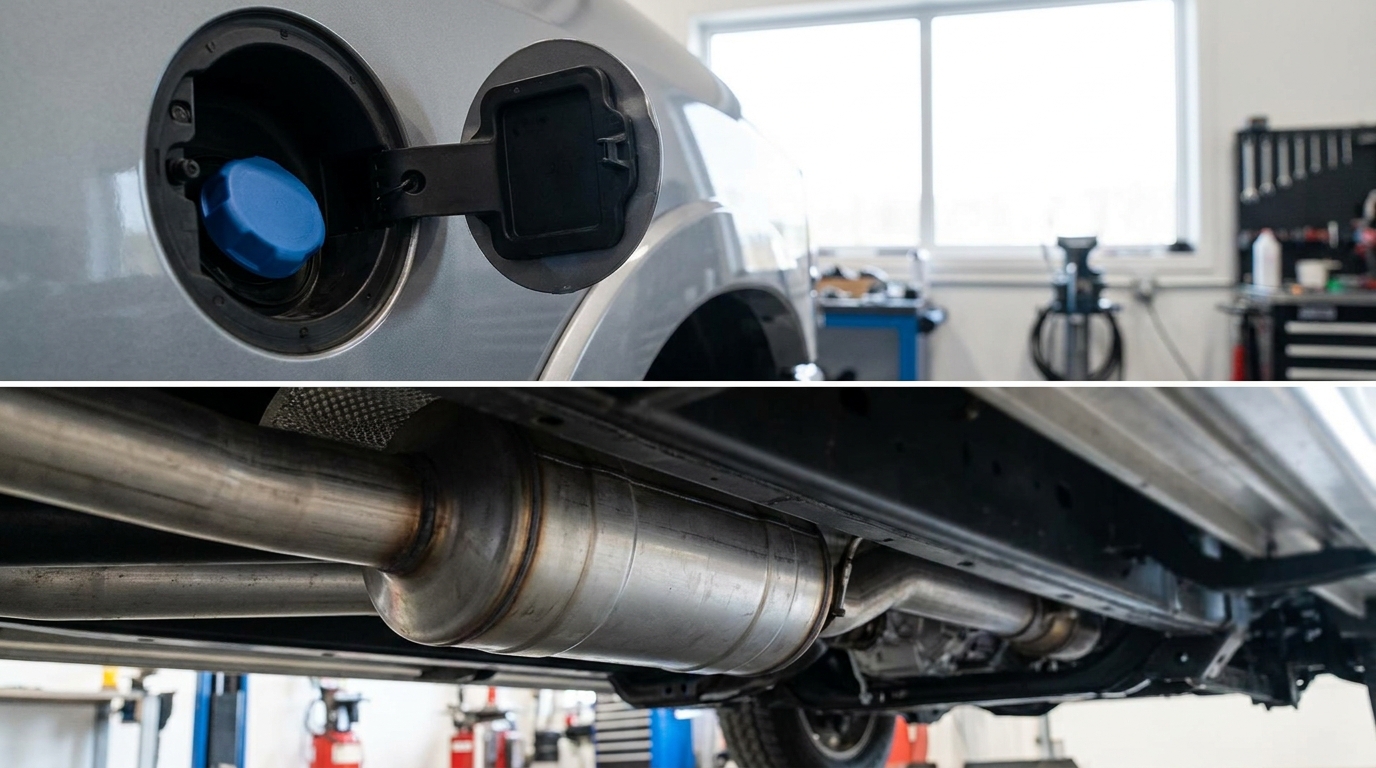
Filling is straightforward once you know where to look. Remove cap from DEF tank (located on drivers side of the vehicle or in fuel door).[2]
And Ram's own maintenance plan puts the check on a short interval, shorter than the oil: Every 7,500 Miles (12,000 Km) ●Check the Diesel Exhaust Fluid (DEF) tank, refill if necessary[3]
The part of this that is actually being fixed
The most useful thing an owner frustrated by this system can know is that the derate behaviour is a live regulatory issue, being worked on through the manufacturers rather than through the aftermarket.
EPA describes the problem in the same terms owners do: Although this derate strategy was intended to ensure compliance with EPA's Tier 4 Emissions Standards ( on-highway , nonroad ), it has caused needless frustration, operational delays, and real economic hardship for countless farmers, truckers, and equipment operators.[1]
And it is doing something specific about it: EPA is issuing guidance to manufacturers for how they may modify DEF systems on new and existing diesel vehicles and nonroad equipment to reduce derates that can limit a vehicles performance to nearly inoperable levels (as low as five miles per hour).[1]
The route runs through software rather than hardware removal: EPA is urging engine and equipment manufacturers to follow EPA's direction and provide software updates for diesel trucks and equipment meeting these new guidelines.[1]
There is a limit on how far that can be pushed, and it explains why this is guidance rather than a recall: By law, EPA cannot mandate field fixes for in-use vehicles and nonroad equipment, which is why the Agency is issuing voluntary guidance to manufacturers on system modifications to reduce derates.[1]
So the honest answer to "is anyone doing anything about the derates" is yes, and the mechanism is a manufacturer software update rather than a kit. That is worth asking your dealer about before spending money on the alternative.
What removing it means legally
The federal rule does not require interpretation to reach a DEF system, because the regulation names running without the fluid as its own example.
Start with the prohibition itself: You may not remove or render inoperative any device or element of design installed on or in engines/equipment in compliance with the regulations prior to its sale and delivery to the ultimate purchaser.[4]
It continues past the sale, which is the half owners assume does not apply to them: You also may not knowingly remove or render inoperative any such device or element of design after such sale and delivery to the ultimate purchaser.[4]
Then comes the example, and it is this system by name: This includes, for example, operating an engine without a supply of appropriate quality urea if the emission control system relies on urea to reduce NO X emissions or the use of incorrect fuel or engine oil that renders the emission control system inoperative.[4]
Urea is DEF. So an empty or bypassed DEF supply on a truck whose emission control system depends on it is not an edge case being read into the rule — it is the illustration the rule itself chose.
EPA states the reach of the statute the same way, in the Act's initials: The CAA prohibits tampering with emissions controls, as well as manufacturing, selling, and installing aftermarket devices intended to defeat those controls.[5]
Read the list: making, selling, installing, and tampering. The owner is one party in it. The shop that fits the kit and the vendor that sold it are inside the same statute.
There is also a design requirement pointing the other way, which is why these systems resist being switched off in the first place. EPA's requirements for vehicles using DEF include a Tamper Prevention System: The system must be designed to prevent tampering or bypassing DEF usage.[1]
The off-road label does not change this
Kits in this category are almost always sold with an off-road or competition-only designation. That designation is not a legal exemption for a truck that is registered and driven on public roads.
EPA addresses the conversion argument directly: The Clean Air Act does not contemplate removing emissions controls from an EPA-certified motor vehicle in order to convert it into a competition vehicle.[6]
There is no mechanism in the Act by which a certified highway truck becomes an uncertified competition vehicle because parts came off it. The label states what a seller intends. It is not a finding about your vehicle.
What a CARB Executive Order is, and why an emissions delete cannot hold one
For an aftermarket part to be legal on a street vehicle in California, it needs an Executive Order exempting it from the state's anti-tampering rule. Owners often assume that is a paperwork question, and for some parts it is.
For this category it is not, and the reason is in the criteria the order is granted under: The Executive Officer shall deny the applicant's exemption request if the device will reduce the effectiveness of the emissions control system.[7]
The authorities record what follows from that as categorical rather than merely unproven: A part whose function is to reduce emissions-control effectiveness can never receive an EO.[7]
So "no EO yet" is the wrong way to read a delete kit's status. A part whose purpose is to reduce the effectiveness of the emissions control system is asking for an exemption on grounds the order is designed to refuse.
What the exposure looks like
Federal civil penalties for tampering are maxima rather than fixed charges, and they are tiered by who committed the violation. The controlling figures are set under 40 CFR §19.4 and adjusted for inflation.
For any person other than a manufacturer or dealer the ceiling is $5,911 per motor vehicle or engine, described in the authority as maximum, per motor vehicle or engine, for any person OTHER THAN a manufacturer or dealer.[7]
The other tier is an order of magnitude higher. For a manufacturer or dealer the ceiling is a maximum of $59,114 per motor vehicle or engine, being the maximum, per motor vehicle or engine, for a MANUFACTURER OR DEALER.[7]
Neither figure is a standard charge. These are MAXIMA, not fixed amounts.[7]
The statute sets out how an actual figure is arrived at, and the factors are the ones you would expect: require the assessor to weigh gravity, economic benefit, business size and compliance history.[7]
Warranty
The consequence that tends to arrive before any enforcement one is contractual.
Tampering, including installation of a defeat device, can void manufacturer warranties.[8]
The fuller position carries a burden of proof that cuts the other way, and it is worth knowing: burden is on the WARRANTOR to show the aftermarket part caused the failure.[7]
So a modification in a system's history is not an automatic forfeit of every future claim. It is, however, an argument you would rather not be having about a truck whose faults it reports to you by design.
The honest summary
A meaningful share of DEF complaints are the system working as documented: a gauge with reserve above the Full mark that can hide 200 miles of use, a needle that parks in the cold, a refill that does not register below the stated temperature, a pump that runs after shutdown, and a warning that distinguishes a fault from a low tank. Knowing that separates the problems with a maintenance answer from the ones without.
And for the derates that genuinely are the system's fault, there is now a route that does not involve removing anything: EPA is pushing manufacturer software updates at exactly that problem, and a dealer is the place to ask about one.
Removal, meanwhile, is prohibited for a registered vehicle by a rule that names running without urea as its own example, the prohibition reaches the seller and the installer as well as the owner, and the off-road label does not move it.
---
Legal notice
This article is educational and describes federal requirements as published by the EPA and in the Code of Federal Regulations, alongside vehicle behaviour as published in Ram owner documentation. It is not legal advice.
Removing, disabling, bypassing or defeating an emissions control device on a vehicle certified for highway use is prohibited under the Clean Air Act, 42 U.S.C. § 7522(a)(3), and 40 C.F.R. § 1068.101(b). The DEF and SCR system is such a control. A part labelled for off-road, competition or closed-course use does not create a legal exemption for a vehicle that is registered or operated on public roads. Tampering, including installing a defeat device, can void manufacturer warranties. Civil penalty figures stated above are statutory maxima under 40 CFR §19.4, not fixed amounts.
Sources
1. 2026 Ram 2500/3500 Owner's Manual — Mopar vehicle information (Stellantis North America) 2. 2026 Ram 2500/3500 Owner's Handbook, maintenance schedule — Mopar vehicle information (Stellantis North America) 3. 40 CFR Part 1068 — eCFR, Office of the Federal Register 4. EPA, Diesel Exhaust Fluid and engine derates — regulations for emissions from vehicles and engines 5. EPA, National Enforcement and Compliance Initiative: Stopping Aftermarket Defeat Devices 6. EPA, Tampering and Defeat Devices enforcement alert 7. Audited controlling-authority record — 40 CFR §19.4 Table 1, CARB Procedures for Exemption of Add-On and Modified Parts, 16 CFR §700.10(c)
Sources & References
- US Environmental Protection Agency — Diesel exhaust fluid — https://www.epa.gov/regulations-emissions-vehicles-and-engines/diesel-exhaust-fluid
- Stellantis North America — Mopar vehicle information (Ram owner documentation) — 105361 67 DJD2 OM EN USC DIGITAL E4 — https://vehicleinfo.mopar.com/assets/publications/en-us-ca/2026/Ram/2500_3500/105361_67_DJD2_OM_EN_USC_DIGITAL_E4.pdf
- Stellantis North America — Mopar vehicle information (Ram owner documentation) — 104749 67 DJD2 OH EN USC DIGITAL E3 — https://vehicleinfo.mopar.com/assets/publications/en-us-ca/2026/Ram/2500_3500/104749_67_DJD2_OH_EN_USC_DIGITAL_E3.pdf
- US Government Publishing Office — Electronic Code of Federal Regulations — Part 1068 — https://www.ecfr.gov/current/title-40/chapter-I/subchapter-U/part-1068
- US Environmental Protection Agency — National enforcement and compliance initiative stopping aftermarket defeat devices — https://www.epa.gov/enforcement/national-enforcement-and-compliance-initiative-stopping-aftermarket-defeat-devices
- US Environmental Protection Agency — Tamperinganddefeatdevices enfalert — https://www.epa.gov/sites/default/files/2020-12/documents/tamperinganddefeatdevices-enfalert.pdf
- The Diesel Dudes — Legal authorities index (internal, 24 primary sources) (internal editorial source — no outbound link)
- govinfo.gov — 42 U.S.C. § 7541 — Compliance by vehicles and engines in actual use (Clean Air Act §207; federal emission warranty) — https://www.govinfo.gov/content/pkg/USCODE-2021-title42/html/USCODE-2021-title42-chap85-subchapII-partA-sec7541.htm
About this article
This article draws on 8 source(s) (citation tiers 1, 2, 4). 1 of 45 declared claims verified as SUPPORTED against frozen source spans. Citations follow the hyperlink-once convention: each source is linked once in the references below and referred to in short form thereafter.