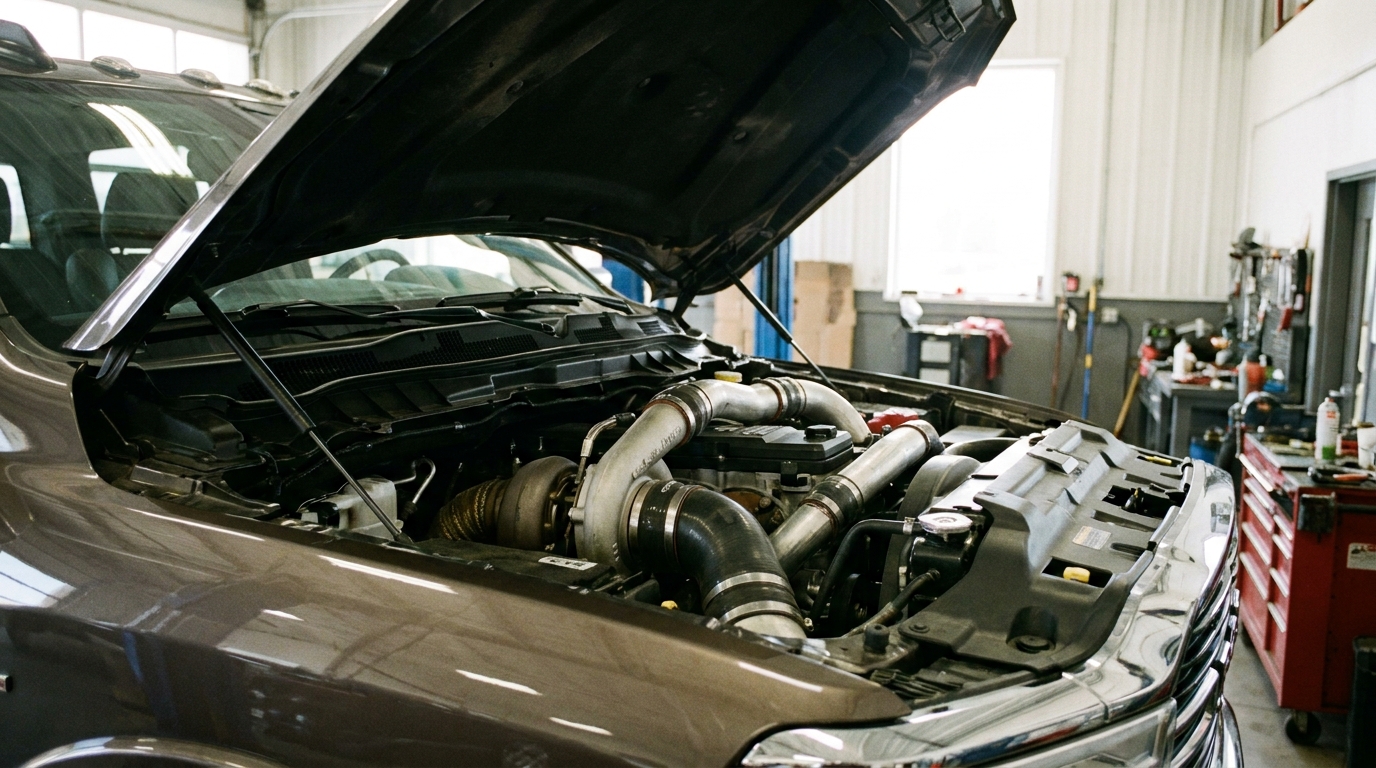
T1a · The Diesel Dudes
6.7 Cummins Years to Avoid: What Actually Changed, Model Year by Model Year
The rule that explains most of the boundaries
On this platform the significant engineering changes track the emissions certification calendar rather than a styling refresh cycle. Every hard boundary below sits next to a regulatory deadline or a driveline change. If you internalise that one rule, the timeline stops looking arbitrary.
That has a direct consequence for buying. The riskiest trucks to buy uninformed are not "bad years" in the abstract — they are the first years of a new aftertreatment architecture, and the years where two quite different engines were sold under one displacement figure.
2007–2012: the first particulate filter generation
The 6.7-liter engine arrived in 2007 Dodge Ram 2500 and 3500 models beginning January 2007, replacing the 5.9-liter engine.[1] At launch it produced 350 horsepower at 3,000 rpm and 650 lb.-ft. of torque at 1,500 rpm.[1]
The reason it arrived at all was regulatory. The engine was built to meet 2007 U.S. federal and state emission requirements, which require a 90-percent reduction in particulate matter and 50-percent reduction in NOx.[1] That is the first diesel particulate filter generation on this class of pickup.
What this means for a buyer. These trucks have a DPF and EGR, but no selective catalytic reduction and therefore no DEF tank. First-generation aftertreatment on any platform is the generation with the least accumulated field knowledge behind its calibration, and the DPF regeneration strategy here is the part owners most often describe as unfamiliar. Nothing about that is a defect claim — it is a statement about what the system does and how much of the maintenance burden is regeneration-related.
The 2007 split. A 2007 truck can carry either the 5.9 or the 6.7. The changeover happened partway through the production run, which is where the aftermarket "2007.5" label comes from. It is not a manufacturer model-year designation. For a 2007 truck, order parts against the VIN and not the model year.
2013–2018: SCR and the DEF system arrive
Selective catalytic reduction joins the aftertreatment system in the 2013 model year, and with it the diesel exhaust fluid tank.
What this means for a buyer. This is the largest single architecture change in the engine's life. The aftertreatment stops being a filter you regenerate and becomes a filter you regenerate plus a chemical process you have to feed and keep from freezing. Your parts list changes, your fault-code vocabulary changes, and a whole category of DEF-related faults becomes possible that simply cannot occur on a 2012.
If you are cross-shopping a 2012 against a 2014, you are not comparing two similar trucks two years apart. You are comparing two different aftertreatment architectures.
2019–2023: one displacement, two genuinely different engines
This is the window that most deserves care, and not for reliability reasons. It is because "6.7 Cummins" stops being a sufficient description of what is in the truck.
By 2020 and 2021 the manufacturer's own model-year fact sheets list two engines. The 6.7-liter Cummins Standard-Output Turbo Diesel produces 370 horsepower and 850 lb.-ft. of torque.[2] The 6.7-liter Cummins High-Output Turbo Diesel produces 400 horsepower and 1,000 lb.-ft. of torque.[2] Ram described the high-output engine as the pickup segment's first 1,000 lb.-ft. of torque engine.
The top rating moves again for 2023. On that fact sheet, the 6.7-liter Cummins High-Output Turbo Diesel produces 420 horsepower and 1,075 lb.-ft. of torque.[3] Ram was the first to achieve the 1,000 lb.-ft. of torque milestone with the Cummins I-6 Turbo Diesel, now rated at a best-in-class 1,075 lb.-ft.
Cummins publishes the same split from its own side, and its ratings table is organised by transmission rather than by trim. The new high-output engine boasts 420 hp and 1,075 lb-ft of best-in-class torque.[4] For the RAM 2500 and 3500 equipped with a 68RFE Auto, HP and torque have increased to 370 hp and 850 lb-ft to provide the right power for these models.[4]
What this means for a buyer. The standard-output and high-output engines are paired with different transmissions. That is why the manufacturer lists them by transmission. Two trucks from the same model year, both badged 6.7 Cummins, can differ by 50 horsepower and 225 lb-ft and sit behind different gearboxes.
The practical failure mode here is not mechanical, it is procurement: people buy or specify against the wrong one of the two, or order driveline parts for the wrong pairing. Before you compare two trucks in this window, establish which engine and which transmission each one has.
Chassis cab trucks are a separate table entirely
If the truck is a 3500, 4500 or 5500 chassis cab rather than a pickup, the pickup ratings do not apply. For the 2019 chassis cab, the manufacturer lists 360 horsepower and 800 lb-ft for the 3500, 4500 and 5500 with the Aisin automatic.
That is a lower rating than the pickup of the same year, and deliberately so — the duty cycle assumed for a commercial chassis cab is different from a pickup's. A chassis cab is not a detuned pickup that someone shortchanged; it is a different application of the same engine.
Published maintenance intervals for that application: maintenance intervals for fuel filter replacement remains at 15,000 miles (24,000 km); the oil change interval stays at 15,000 miles (24,000 km) and is duty cycle based; and the interval for the Fleetguard breather filter has been extended to 75,000 miles.
The maintenance requirement that damages aftertreatment when ignored
One published requirement deserves its own section because ignoring it converts a maintenance decision into an aftertreatment repair.
The Cummins 6.7L Turbo Diesel engine requires low-ash engine oil, and failure to use this type of oil can result in serious damage to the exhaust aftertreatment system. The manufacturer specifies oil meeting CES 20081.
The mechanism is straightforward. Ash is the residue that does not burn off during a particulate filter regeneration. Regeneration removes soot; it does not remove ash. Ash accumulates until the filter is cleaned or replaced. Using a higher-ash oil accelerates that accumulation on every mile the truck covers, and the cost lands on the filter rather than on the oil.
For the pickup, the published guidance is to replace the engine oil and oil filter every 15,000 miles (24,000 km) or 12 months, or sooner if prompted by the oil change indicator system, and that under no circumstances should oil change intervals exceed 15,000 miles (24,000 km) or 12 months, whichever comes first. Cummins also recommends that every 3,000 miles (4,800 km) you check the engine oil level at least 30 minutes after a fully warmed engine is shut off.
A truck with a documented oil history using the specified oil is a materially different proposition from one without, and it is one of the few reliability-relevant facts about a used diesel that a buyer can actually verify.
So which years should you avoid?
Framed honestly, the answer is that no model year of this engine is one we can tell you to avoid on published manufacturer evidence, because that is not a thing manufacturers publish. What we can tell you is where the risk of buying the wrong truck concentrates:
Buy a 2007 without checking the VIN and you may be buying a 5.9 when you wanted a 6.7, or ordering 6.7 parts for a 5.9. This is the single most common ordering mistake on the platform.
Buy a 2013-or-later without wanting a DEF system and you have bought a maintenance and fault-code category you did not want. That is an architecture preference, not a defect.
Buy a 2019–2023 truck without establishing standard-output versus high-output and you may have specified the wrong engine, the wrong transmission, or both, and any performance expectation you formed from a review of "the 6.7" may have been about the other engine.
Buy any of them with no oil-service history and the aftertreatment condition is unknown, because the requirement that protects it is an oil specification that is easy to ignore and invisible afterwards.
That is a less satisfying answer than a list of bad years. It is also one you can check.
Inspecting a used one: what is actually checkable
Since the model year will not tell you whether a specific truck was looked after, here is what will. These are ordered by how much they tell you per minute spent.
Service documentation, specifically oil. Ask what oil was used, not just whether it was changed. The specification is the thing that protects the aftertreatment, and a stack of receipts showing the correct low-ash oil at sensible intervals is the single most informative document a seller can produce. No records is not automatically a red flag on an older truck, but it does mean the aftertreatment condition is unknown rather than good.
Regeneration behaviour. Ask how the truck is used. A truck that has spent its life on short trips has interrupted more regeneration cycles than one that runs long highway distances, and its particulate filter carries the consequence. Duty cycle is a better predictor of aftertreatment condition than mileage.
Aftertreatment fault history. A truck that has thrown repeated DEF or DPF faults has a history worth understanding before purchase, particularly if the fix each time was a sensor replacement. Repeated sensor replacement for the same fault sometimes indicates the sensor was reporting something real.
Evidence of prior modification, and evidence of its reversal. A truck that was modified and returned to stock is a different proposition from one that was never touched, and both are different from one still modified. Look for the physical hardware, and treat a suspiciously new-looking aftertreatment component on a high-mileage truck as a question rather than a bonus.
Cooling system condition. EGR cooler failure is a documented failure mode on this platform, and coolant loss without an external leak is the symptom worth taking seriously.
Which engine and which transmission. For a 2019-or-later truck, confirm standard-output versus high-output against the VIN, and confirm the transmission with it, because the manufacturer's own ratings tables are organised that way.
What a test drive tells you. Load it if you can. The conditions that reveal fuel delivery restriction, turbocharger issues and transmission behaviour are load conditions, and an unloaded drive around a block is close to uninformative on a truck built to tow.
Cold-start behaviour, if you can arrange to see it. A genuinely cold first start tells you more about glow-system and battery condition than any warm start will, and it is the one condition most sellers will have quietly avoided before you arrive. If the truck is already running when you get there, that is worth noting rather than reading as sinister — but it does mean you have not seen the start.
Where the truck lived. Road salt exposure drives frame and brake-line corrosion, and corrosion is the one category of problem on a used heavy-duty truck that is genuinely hard to price and genuinely hard to reverse. An underbody inspection is worth more minutes than most buyers give it.
Legal and warranty notes
This article is a technical and buying reference and does not recommend modifying any emissions system. Because every generation above is defined by its emissions hardware, three points apply.
Removing or disabling a factory emissions control system on a highway-registered vehicle violates 42 U.S.C. 7522(a)(3), and this is a federal civil violation. Civil penalties reach up to $5,911 per motor vehicle or engine for a person other than a manufacturer or dealer, and up to $59,114 per motor vehicle or engine for a manufacturer or dealer. Basis: 42 U.S.C. 7524, amounts per 40 CFR 19.4, assessed on or after 2025-01-08.[5]
An "off-road use only" label does not create a legal exemption for the buyer or the seller. The test is the vehicle's original certification, not where or how it is driven.
Tampering with, removing or altering a factory emissions system gives the manufacturer immediate, legally protected grounds to void the powertrain and emissions warranties. On a used-truck purchase this compounds: a modified truck may arrive with its warranty position already forfeited by a previous owner's work.
For added performance on a registered truck, the compliant path is a part with a valid, part-specific CARB Executive Order number. An Executive Order is required for legal installation in California, and a part without one fails California Smog Check. 50-state-legal parts are the category to shop in.
Common questions
Is there a single worst year for the 6.7 Cummins? Not one we can support from published manufacturer sources. The boundaries that matter are architectural: 2007 (two engines in one model year), 2013 (SCR and DEF arrive), and 2019 onward (two ratings and two transmissions under one badge).
How do I tell a standard-output from a high-output truck? By rating and transmission, and check both against the truck's own model year rather than a general figure. The standard-output engine produces 370 horsepower and 850 lb.-ft. of torque and sits behind the 68RFE automatic.[2] The high-output engine sits behind the Aisin, and its rating moved during this window: it produces 400 horsepower and 1,000 lb.-ft. of torque on the 2020 fact sheet, and 420 horsepower and 1,075 lb.-ft. of torque on the 2023 one.[2] Confirm against the VIN rather than the badge.
Does the 2013 SCR system make the truck worse? It makes it different. It adds a fluid to maintain and a category of faults that cannot occur without it, and it exists because the engine had to meet a tighter NOx standard.
Which fluids and intervals actually matter most? Low-ash engine oil meeting CES 20081, at no more than 15,000 miles (24,000 km) or 12 months. That single specification protects the most expensive part of the exhaust system.
---
*Written by The Diesel Dudes Technical Team. Ratings and intervals are quoted from Cummins and Ram published material.*
Sources & References
- Stellantis North America (Ram Trucks / Dodge) media newsroom — Newsrelease.do — https://media.stellantisnorthamerica.com/newsrelease.do?id=6229&mid=97
- Stellantis North America (Ram Trucks / Dodge) media newsroom — Newsrelease.do — https://media.stellantisnorthamerica.com/newsrelease.do?id=21131
- Stellantis North America (Ram Trucks / Dodge) media newsroom — Newsrelease.do — https://media.stellantisnorthamerica.com/newsrelease.do?id=24053&mid=71
- Cummins Inc. — Cummins 67l turbo diesel 2021 — https://www.cummins.com/engines/products/cummins-67l-turbo-diesel-2021
- U.S. Environmental Protection Agency — Stopping Aftermarket Defeat Devices for Vehicles and Engines — https://www.epa.gov/enforcement/national-enforcement-and-compliance-initiative-stopping-aftermarket-defeat-devices
About this article
This article draws on 5 source(s) (citation tiers 1, 2). 6 of 21 declared claims verified as SUPPORTED against frozen source spans. Citations follow the hyperlink-once convention: each source is linked once in the references below and referred to in short form thereafter.