T1a · The Diesel Dudes
2024 Ram 2500 Fuel Filter Location: How the System Is Laid Out and How to Find Yours
What truck we are talking about
The 2024 Ram 2500 is offered with a gas V-8 and with the Cummins diesel. On the diesel side, the 6.7-liter Cummins Standard-Output Turbo Diesel produces 370 horsepower and 850 lb.-ft. of torque (Ram 2500 and 3500).[1] The high-output engine — the 6.7-liter Cummins High-Output Turbo Diesel produces 420 horsepower and 1,075 lb.-ft. of torque — is a Ram 3500 engine, so a 2500 buyer is generally looking at the standard-output truck.[1]
The gas engine in the same truck, the 6.4-liter HEMI V-8, delivers 410 horsepower at 5,600 rpm and 429 lb.-ft. of torque at 4,000 rpm.[2] If your 2500 is the gas truck, most of this article does not apply to you: gasoline fuel filtration in this class is typically an in-tank arrangement with no scheduled service interval of the kind described below.
Establish which engine you have before you buy filters. This sounds obvious and is the most common reason people end up with parts that do not fit.
Why a diesel has two filtration stages
The reason comes down to what a common rail system does to fuel.
Cummins describes the architecture directly: in a common rail setup, diesel fuel is stored in a high-pressure rail that supplies fuel to each injector independently. This approach ensures a constant and consistent high pressure, allowing for precise control over fuel injection timing and quantity. The common rail injectors operate in conjunction with other fuel system components, such as fuel pumps, fuel lines, and filters, ensuring a clean and efficient fuel supply.
Two properties of that design drive the filtration strategy.
Injectors meter fuel through very small orifices at very high pressure. Particulate contamination that would be harmless in a low-pressure system becomes an abrasive at rail pressure. The tolerance for solids is correspondingly tight.
Diesel fuel carries water. Water enters through condensation in tanks, through the supply chain, and through humidity. Water in a high-pressure fuel system is not just a contaminant, it is a corrosion and lubrication problem — diesel fuel lubricates the pump and the injectors, and water displaces that lubrication where it collects.
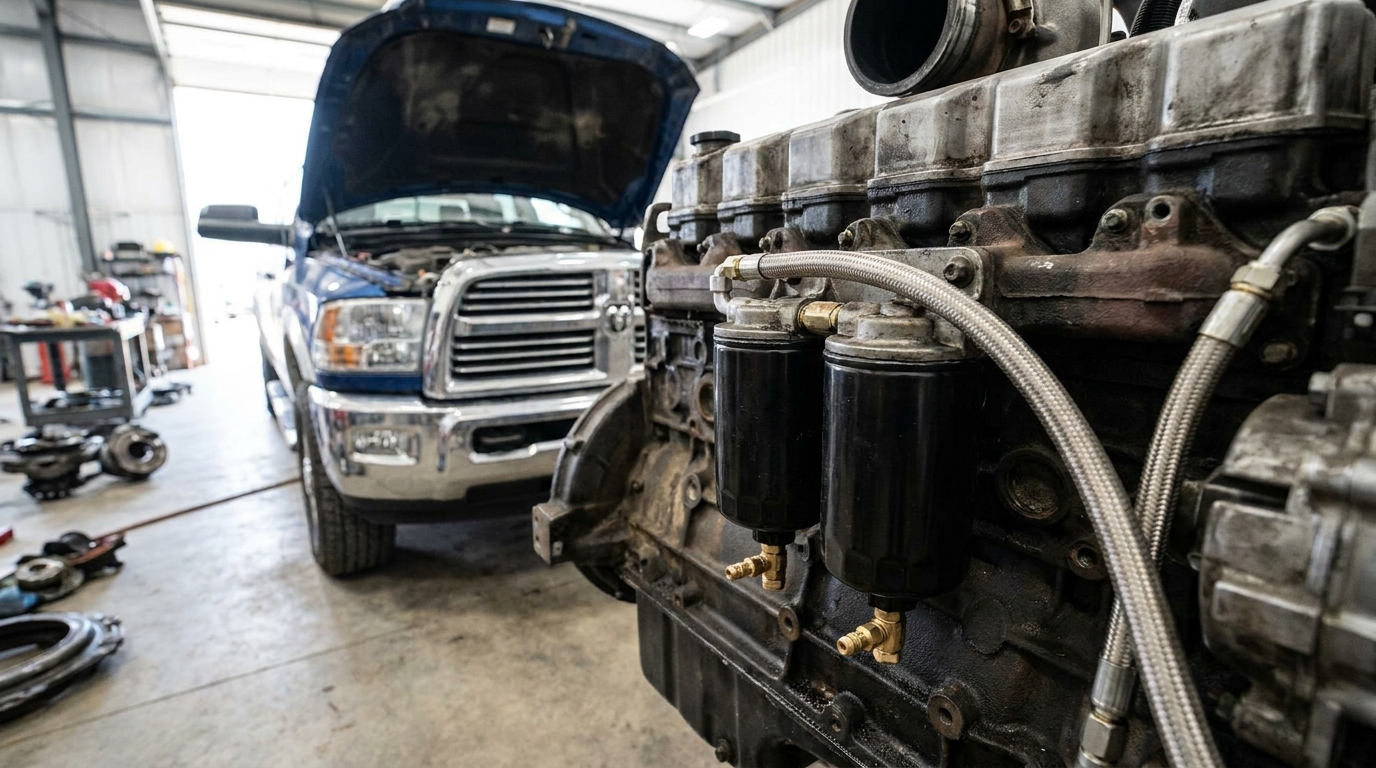
So the system separates the two jobs. One stage is oriented toward water separation and coarser particulate capture, sitting upstream where it can protect the high-pressure pump. The other is a finer filtration stage sitting downstream, closest to the injectors, catching anything that made it past the first stage or was generated within the system.
That is why "where is the fuel filter" has two answers, and why replacing one and not the other is a partial service.
The service interval the manufacturer publishes
For the 6.7L Cummins Turbo Diesel in the 2019 chassis cab application, Cummins publishes that maintenance intervals for fuel filter replacement remains at 15,000 miles (24,000 km).[3]
That figure is quoted here with its source deliberately attached, because attribution matters more than the number. It is published for a chassis cab application and a specific model year. Do not read it across to your 2024 pickup as a fact. Intervals are application-specific and duty-cycle-sensitive, and the correct interval for your truck is the one in your truck's own maintenance schedule.
What the figure is genuinely useful for is calibration of expectations: fuel filter service on this engine family is a scheduled maintenance item measured in tens of thousands of miles, not a once-in-the-life-of-the-truck job, and not something to do at every oil change either.
For context on how the intervals sit relative to each other in that same published schedule, the oil change interval stays at 15,000 miles (24,000 km) and is duty cycle based, and the interval for the Fleetguard breather filter has been extended to 75,000 miles.
How to find the answer for your specific truck
Four routes, in the order we would use them.
1. The owner's manual for your VIN. This is the authoritative answer and it is free. It gives you the location, the interval and the correct part for the exact configuration you own, which no generic article can.
2. Cummins QuickServe Online. Cummins provides parts and service documentation by engine serial number. It is registration-gated, which is why this article does not quote from it, but it is the manufacturer's own service documentation and it is the right place for a definitive answer.
3. The engine serial number, not the model year. On this platform, model year alone repeatedly fails as a parts key. The 6.7 has been sold in standard-output and high-output forms behind different transmissions, and in pickup and chassis cab applications with different published intervals. The serial number resolves what the model year leaves ambiguous.
4. A physical inspection with the right expectation. Once you know the truck has two filtration stages, finding them is a much easier task than searching for "the" filter. You are looking for two housings, not one.
Doing the job without creating a second problem
A few points that come up repeatedly, none of which depend on the specific location.
Prime the system properly. A common rail system that has ingested air after a filter change will crank without starting, and the failure looks alarming. Follow the priming procedure in the vehicle documentation rather than cranking repeatedly, which is hard on the starter and on the high-pressure pump.
Drain the water separator on schedule, not just at filter changes. The water separation stage does its job continuously and needs draining on its own cadence. This is the single most-skipped item in diesel fuel maintenance.
Do not pre-fill filters with unfiltered fuel. Filling a filter housing from a fuel can before installation introduces exactly the contamination the filter exists to remove, on the clean side of the element. It is a well-intentioned habit that defeats the part.
Replace both stages when the schedule calls for both. Replacing the accessible one and deferring the other because it is harder to reach leaves the system half-serviced while the maintenance log says it was done.
Use the specified filter. Filtration efficiency and water-separation performance are engineered properties of the element, not marketing claims. A filter that fits physically is not necessarily a filter that filters to the specification the injection system was designed around.
What a restricted fuel filter actually feels like
Filters are usually replaced on schedule, but they are sometimes replaced because something felt wrong. It is worth knowing which symptoms point this way and which do not, because "replace the fuel filters" is a common piece of advice given for problems it will not fix.
Power loss that appears under load and clears when you back off. A restricted filter limits volume. At idle and light throttle the demand is low enough that the restriction is invisible; under load the system cannot supply what the engine is asking for. A truck that pulls normally until it is working hard, then flattens, fits this pattern.
Symptoms that worsen as the tank empties. As fuel level drops, the pump works against a greater lift, and a marginal restriction becomes a real one.
Hard starting after the truck has sat. This can indicate a filter housing that is losing prime, which is often a seal rather than the element.
Rough running that improves as the engine warms. Cold fuel is more viscous, and a partially restricted element restricts more when it is cold.
What a fuel filter will generally *not* fix: a persistent check-engine light with an aftertreatment code, DEF system faults, or a derate event. Those have their own causes, and replacing filters in response to them costs parts and time without touching the mechanism.
If you suspect restriction, the diagnostic worth doing is a fuel pressure reading under load rather than a visual inspection of the element. A filter that looks dirty may be fine, and one that looks acceptable may be restricting, because what matters is differential pressure and that is not a thing you can see.
Water separation, and why it gets skipped
The water separation stage is the part of this system most likely to be neglected, because draining it is quick, unglamorous and produces no visible improvement when the fuel is clean.
Water reaches a diesel tank through condensation as the tank breathes with temperature changes, through the supply chain, and in greater quantity in humid climates and on trucks that sit part-used for long periods. It collects at the bottom of the separator because it is denser than diesel.
Two failure modes make this worth a habit rather than an afterthought. Water displaces the lubrication that diesel provides to the injection pump and injectors, and those components are not designed to run dry even briefly. And standing water in a fuel system supports microbial growth, which produces a sludge that blocks filters far faster than particulate alone.
Drain it on its own schedule rather than only at filter changes, and drain it more often in winter and in humid conditions.
Cold weather
Diesel gels as temperature drops, and the fuel filter is where gelling first becomes a running problem, because the element is the finest restriction in the system.
Winter-blended fuel and correct additive use are the primary defences. A truck that starts and then dies shortly afterward in very cold conditions is exhibiting a classic filter gelling pattern rather than an electrical fault, and the response is fuel management, not parts replacement.
If the truck is stored outside in a cold climate, keeping the tank full reduces the air volume available to condense moisture, which addresses the water problem and the gelling problem at the same time.
Before you start the job
A short preparation list prevents most of the avoidable outcomes.
Have the correct filters for your configuration on hand and verified against your truck's documentation before you drain anything. Have a container ready — you will be releasing fuel, not a trace. Work on a cool engine near a hot exhaust system. Have the priming procedure open in front of you rather than trusting recall. And note the odometer reading into the maintenance record when you finish, because the value of a filter change to the next owner is entirely in the documentation.
Legal and warranty notes
This article covers routine fuel system maintenance and does not recommend modifying any emissions system.
It is worth being explicit about the boundary, because fuel system work sits next to emissions hardware on this engine. Removing or disabling a factory emissions control system on a highway-registered vehicle violates 42 U.S.C. 7522(a)(3) and is a federal civil violation. Civil penalties reach up to $5,911 per motor vehicle or engine for a person other than a manufacturer or dealer, and up to $59,114 per motor vehicle or engine for a manufacturer or dealer. Basis: 42 U.S.C. 7524, amounts per 40 CFR 19.4, assessed on or after 2025-01-08.[4] Replacing a fuel filter is maintenance; bypassing aftertreatment is not, and the two should not be discussed as though they sit on a spectrum.
An "off-road use only" label does not create a legal exemption for the buyer or the seller. The test is the vehicle's original certification, not where or how it is driven.
Tampering with, removing or altering a factory emissions system gives the manufacturer immediate, legally protected grounds to void the powertrain and emissions warranties. Routine maintenance performed with correct parts does not — keeping receipts and using specified filters is what protects a warranty position, not what threatens it.
Where performance parts are concerned, a part needs a valid, part-specific CARB Executive Order number to be legally installed in California. A part without an Executive Order fails California Smog Check, and 50-state-legal parts are the category to shop in for a registered truck.
Common questions
How many fuel filters does a 2024 Ram 2500 diesel have? The common rail architecture uses filtration before and after the high-pressure pump, so plan on servicing two stages rather than one. Confirm the exact count and part numbers against your truck's documentation.
How often should the fuel filters be replaced? Follow your truck's own maintenance schedule. For scale, Cummins publishes a 15,000-mile (24,000 km) fuel filter replacement interval for the 2019 chassis cab application of this engine; that is a useful order-of-magnitude reference and not a specification for your pickup.
Can I just replace the easy one? That leaves the system half-serviced. The two stages do different jobs, and the one protecting the injectors is not the one protecting the pump.
Why does my truck crank but not start after a filter change? Most commonly, air in the system. Use the documented priming procedure rather than extended cranking.
Does a fuel filter change affect emissions compliance? No. It is scheduled maintenance with the specified part, and it is the kind of service that keeps the fuel and aftertreatment systems operating as designed.
---
*Written by The Diesel Dudes Technical Team. Where we could not trace a specific to published manufacturer documentation, we said so instead of filling the gap.*
Sources & References
- Stellantis North America (Ram Trucks / Dodge) media newsroom — Newsrelease.do — https://media.stellantisnorthamerica.com/newsrelease.do?id=24053&mid=71
- Stellantis North America (Ram Trucks / Dodge) media newsroom — Newsrelease.do — https://media.stellantisnorthamerica.com/newsrelease.do?id=25278&mid=69
- Cummins Inc. — 67l cummins turbo diesel 2019 chassis cab — https://www.cummins.com/engines/products/67l-cummins-turbo-diesel-2019-chassis-cab
- U.S. Environmental Protection Agency — Stopping Aftermarket Defeat Devices for Vehicles and Engines — https://www.epa.gov/enforcement/national-enforcement-and-compliance-initiative-stopping-aftermarket-defeat-devices
About this article
This article draws on 4 source(s) (citation tiers 1, 2). 2 of 12 declared claims verified as SUPPORTED against frozen source spans. Citations follow the hyperlink-once convention: each source is linked once in the references below and referred to in short form thereafter.