T1b · The Diesel Dudes
2018 Cummins Delete: What the Term Means, What Federal Law Says, and What the Legal Paths Are
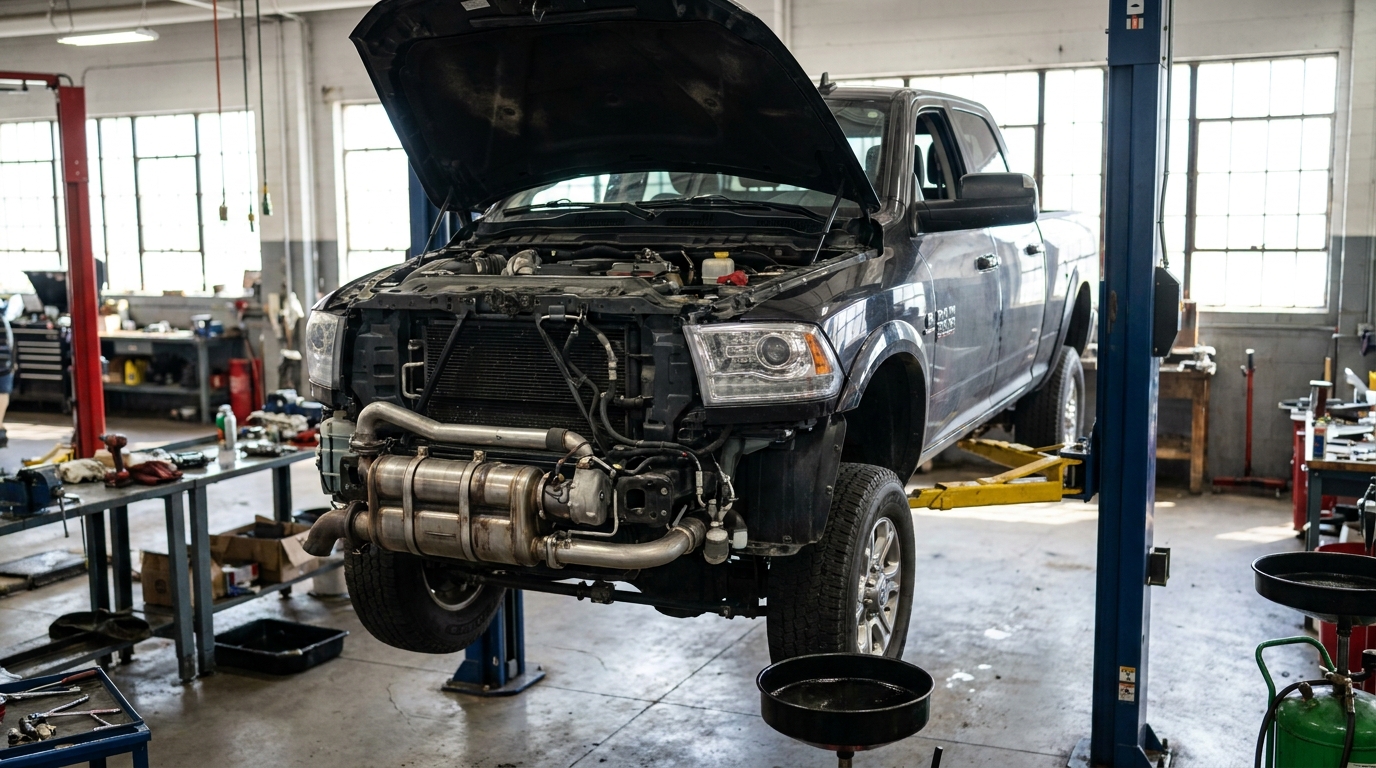
What the 2018 truck actually has
A 2018 Ram heavy-duty with the 6.7-liter Cummins sits in the second aftertreatment generation of this engine. Selective catalytic reduction arrived for the 2013 model year, so a 2018 truck carries the full modern arrangement: a diesel particulate filter, an exhaust gas recirculation system, and an SCR system with a diesel exhaust fluid tank.
That combination is what people are referring to when they use the word "delete" — the removal or bypass of one or more of those systems, usually alongside calibration changes so that the engine control module does not respond to the missing hardware.
Understanding what each system does explains why they are maintenance-intensive and why the maintenance is not optional.
The diesel particulate filter captures soot. It is periodically regenerated, which burns accumulated soot off at high temperature. Regeneration removes soot but does not remove ash, and ash accumulates permanently until the filter is cleaned or replaced.
Exhaust gas recirculation routes a metered portion of exhaust back into the intake to lower peak combustion temperature, which suppresses NOx formation. Carbon accumulation and cooler failure are documented failure modes on this platform.
Selective catalytic reduction injects diesel exhaust fluid into the exhaust stream, where it converts NOx into nitrogen and water across a catalyst. It is a chemical process, which is why it needs a consumable.
What the EPA says, in the EPA's own words
This is the part most articles paraphrase into vagueness. It is clearer unparaphrased.
On the parts themselves: it is a violation of the CAA to manufacture, sell, or install a part for a motor vehicle that bypasses, defeats, or renders inoperative any emission control device. That sentence covers three separate activities — manufacture, sale and installation — which is why liability in this area is not confined to the vehicle's owner.
On software: for example, computer software that alters diesel fuel injection timing is a defeat device. Tuning is not a separate category that sits outside the hardware rules. The agency names calibration software explicitly.
On tampering: the CAA prohibits anyone from tampering with an emission control device on a motor vehicle by removing it or making it inoperable prior to or after the sale or delivery to the buyer. "Prior to or after" is doing real work in that sentence. A modification performed after purchase, by the owner, in their own driveway, is inside the prohibition.
On why the agency treats this as a priority: defeat devices, which are often sold to enhance engine performance, work by disabling a vehicle's emission controls, causing air pollution. And on enforcement outcomes: as a result of EPA enforcement, some of the largest manufacturers of defeat devices have agreed to pay penalties and stop the sale of defeat devices.
The statutory anchor for all of this on a highway vehicle is 42 U.S.C. 7522(a)(3), and removing or disabling a factory emissions control system on a highway-registered vehicle violates it. This is a federal civil violation.
The penalties, with their basis
Precision matters here, because inaccurate penalty figures circulate widely in this corner of the internet and the wrong number is worse than no number.
Civil penalties reach up to $5,911 per motor vehicle or engine for a person other than a manufacturer or dealer, and up to $59,114 per motor vehicle or engine for a manufacturer or dealer. Basis: 42 U.S.C. 7524, amounts per 40 CFR 19.4, assessed on or after 2025-01-08.[1]
Two things about that structure are commonly missed. The figures are **per motor vehicle or engine**, not per incident of driving. And the higher tier attaches to manufacturers and dealers, which is a category that turns on what an entity does commercially rather than on how large it is.
The "off-road use only" label
This label appears on essentially every product in this category, and it is widely understood to be a legal shield. It is not.
The off-road designation is not a legal exemption and does not legally protect the buyer or the seller where the part can be installed on a vehicle originally certified for on-road use. The label is a required piece of disclosure. It does not change the legal status of installing the part on a registered truck, and it does not transfer liability from a seller to a buyer.
The use cases that are genuinely available are the ones where the vehicle is actually not a highway vehicle: closed-course competition, off-road-only equipment, and vehicles not registered for highway use. Those are real categories with real participants. They are also substantially narrower than the way the label is generally read.
Warranty consequences
Tampering with, removing or altering a factory emissions system gives the manufacturer immediate, legally protected grounds to void the powertrain and emissions warranties.
On a 2018 truck this may read as academic, since much of the original coverage will have expired by now. Two things keep it relevant. Extended and powertrain-specific coverage can run longer than people assume, and the position transfers with the vehicle — a truck bought used with previous modification carries the consequences of work its current owner did not perform and may not know about.
That last point is worth pausing on if you are shopping. A modified truck is a truck whose warranty position and emissions-compliance status are both already determined, and neither is easy to reverse.
The legal paths for a registered 2018 truck
This is the section that is usually missing, and it is the one most owners searching this term actually need.
Repair or restore the existing system. The most direct route is fixing what has failed with OEM or OEM-equivalent parts. A failed EGR cooler is a replaceable component. A loaded particulate filter can in many cases be professionally cleaned rather than replaced. This keeps the truck compliant and its warranty position intact.
Address the maintenance inputs that damage aftertreatment. A substantial share of aftertreatment trouble on this engine traces back to maintenance rather than to component defect. The Cummins 6.7L Turbo Diesel engine requires low-ash engine oil, and failure to use this type of oil can result in serious damage to the exhaust aftertreatment system. Ash is the residue regeneration cannot remove, so oil specification directly determines how quickly a filter loads with material that never leaves. Using the specified oil is the cheapest aftertreatment protection available.
Let regeneration complete. Interrupted regeneration cycles are self-compounding: a filter that never finishes a cycle carries more soot into the next one. Duty cycles that consist of many short trips are the hardest case, and the fix is operational rather than mechanical.
Choose emissions-intact performance parts. If the goal is capability rather than maintenance relief, the compliant route is a part carrying a valid, part-specific CARB Executive Order number. A performance part needs an Executive Order to be legally installed in California, and a part without one fails California Smog Check. 50-state-legal hardware and emissions-intact calibration exist precisely for street-registered vehicles, and they are the category to shop in for one.
Diagnose before replacing. A DEF-system fault is frequently a sensor or a quality issue rather than a failed catalyst, and derate events often trace to something considerably cheaper than the component the code appears to name. Diagnosis first is not caution for its own sake; it is usually the lower-cost path.
About the January 2026 DOJ change
This comes up constantly and is routinely reported in a way that overstates it.
Federal criminal prosecutions for OBD tampering have ceased. Federal civil penalties remain fully active, and state-level criminal prosecution is unaffected. The civil exposure described earlier in this article — the per-vehicle amounts, the coverage of manufacture, sale and installation — is unchanged by that policy shift.
Anyone presenting the DOJ change as a reduction in a vehicle owner's or a seller's legal risk is describing only one of three exposures and omitting the two that remain.
About the March 2026 EPA DEF-sensor guidance
Similarly misreported. The EPA guidance eases requirements around isolated DEF sensor faults in order to prevent supply-chain-induced derates. It does not authorise bypassing the SCR system, and it does not legalise SCR or DEF removal. It addresses a narrow, specific failure scenario.
Why certification is the framework everything else hangs off
The prohibitions above are easier to reason about once you know what they are protecting, and the answer is a certification system rather than a set of standalone rules about parts.
New vehicles and engines must have an EPA-issued certificate of conformity before import or entry into the United States demonstrating that the engine or vehicle conforms to all applicable emissions requirements. That certificate is issued against a specific configuration — a defined combination of engine, calibration and aftertreatment hardware. The CAA also requires emissions labels for certified vehicles and engines, which is what the underhood emissions label on your truck is.
That framing explains the shape of the rules. A modification is not prohibited because a regulation lists that specific part. It is prohibited because it moves the vehicle away from the configuration its certificate was issued against. This is why the EPA's language covers manufacture, sale and installation, and why software counts equally with hardware: all three change the certified configuration.
It also explains the scale of what certification is holding back. The EPA notes that uncertified vehicles and engines can emit harmful air pollutants at 30% or more above allowable standards. The certificate is not paperwork attached to a clean vehicle; it is the mechanism by which the vehicle is clean.
State law is a second, separate layer
Everything above is federal. States regulate on top of it, and state exposure is where a great deal of practical enforcement actually happens.
The variation is wide. California operates the strictest regime, administered through a Smog Check programme that inspects for the presence and function of emissions equipment and which requires a valid, part-specific CARB Executive Order number for aftermarket parts. The Section 177 states have adopted California's standards, which extends that framework well beyond California itself. Other states run inspection programmes of varying scope, some county-by-county rather than statewide, and some run none at all.
Two points matter more than the details.
A state with no inspection programme is not a state where modification is legal. The federal prohibition applies regardless of whether any state agency is checking. Absence of inspection is absence of one detection mechanism, not absence of a rule.
State criminal exposure is unaffected by the federal criminal policy change. This is the half most commonly dropped when the January 2026 DOJ shift is discussed.
Because inspection regimes differ so much and change, verify the position for your own state rather than relying on general summaries — including this one.
Resale and inspection consequences
A modified truck carries consequences that arrive later, at moments the owner does not choose.
Sale. The buyer pool narrows to buyers who want a modified truck, and the compliance status transfers with the vehicle. A seller who does not disclose has a problem; a buyer who does not ask acquires one.
Relocation. A truck that was never inspected in its home state becomes a problem the first time it needs to register somewhere with an inspection programme.
Insurance and commercial use. A vehicle used commercially may face compliance requirements from a direction entirely separate from state registration.
Reversal cost. Returning a truck to compliant configuration usually costs more than not modifying it, because the original components have to be sourced — and on a truck where they were removed rather than retained, they have to be bought.
The general point: the decision looks like a one-time transaction and behaves like a standing condition of the vehicle.
What this article does not do
It does not tell you how to remove an emissions system, and it does not tell you how to keep a modified truck from setting codes. Those are the two things this search term most often leads to elsewhere, and providing them would mean providing instructions for an act that federal law prohibits on a registered vehicle.
If your truck is a genuine off-highway or competition vehicle, that is a different legal situation, and the right first step is confirming its registration status rather than starting from a parts list.
Common questions
Is a delete legal on a 2018 Ram 2500 that I drive on the road? No. Removing or disabling a factory emissions control system on a highway-registered vehicle violates 42 U.S.C. 7522(a)(3), and it is a federal civil violation.
Does an "off-road use only" label make it legal? No. That designation is not a legal exemption and does not legally protect the buyer or the seller where the part can be installed on a vehicle originally certified for on-road use.
Is tuning treated differently from hardware? No. The EPA names calibration software directly: computer software that alters diesel fuel injection timing is a defeat device.
Did the January 2026 DOJ announcement make this legal? No. Federal criminal prosecution for OBD tampering ceased; federal civil penalties remain fully active and state criminal exposure is unaffected.
My DPF is loaded and the quote is high. What are my options? Professional cleaning rather than replacement is often available, diagnosis frequently identifies a cheaper root cause than the code suggests, and correcting oil specification and regeneration behaviour addresses the mechanism that loaded the filter in the first place.
What actually protects the aftertreatment long-term? Low-ash oil to the manufacturer's specification, at the published interval, and letting regeneration cycles complete. Those two habits determine most of the outcome.
---
*Written by The Diesel Dudes Technical Team. Federal statements in this article are quoted from EPA published material and the United States Code; penalty figures carry their basis.*
Sources & References
- U.S. Environmental Protection Agency — Stopping Aftermarket Defeat Devices for Vehicles and Engines — https://www.epa.gov/enforcement/national-enforcement-and-compliance-initiative-stopping-aftermarket-defeat-devices
About this article
This article draws on 1 source(s) (citation tiers 1). 1 of 8 declared claims verified as SUPPORTED against frozen source spans. Citations follow the hyperlink-once convention: each source is linked once in the references below and referred to in short form thereafter.